Remembering Betty Krueger

Now that I’ve processed a little bit: I got a phone call from my dad yesterday morning that my Grandma, Betty Krueger, had passed. (Thom and I are now officially out of grandparents :/) She’s been touch and go for a couple of years, was in her 90s, and lived a very good life. So while there is grief and sorrow, there is also lots of joy to remember.

She is one of the main people who helped me manage through my first year at college, away from all my family and friends that I knew. We wrote letters back and forth (like actual, real-live, snail-mail letters!) and sent each other little things we found: newspaper articles, post-cards, pictures. She sent me super comfy and fluffy shoes right as the weather turned cold. She shared stories about her time in school. She was progressive for her time, and went to college and traveled abroad. She sent me some postcards she’d collected from when she visited Greece in her 20s 😉

I’ll probably be heading down for the memorial in Mississippi in a few weeks, though a date hasn’t been chosen yet. Some prayers for me and mine would be very welcome.  It’s weird to feel out of words, and out of prayers, but some things, like this, are harder to do for yourself than they are for others.

Ancestors, light the fires along the way,
To brighten the path as Betty travels.
Prepare the hall for a great feast,
To welcome her when she arrives.
Show her the way, and where to drink,
And guide her in this new role.
Watch over her as she makes this transition,
As she begins this new adventure.

Revisiting the Home Shrine Essay

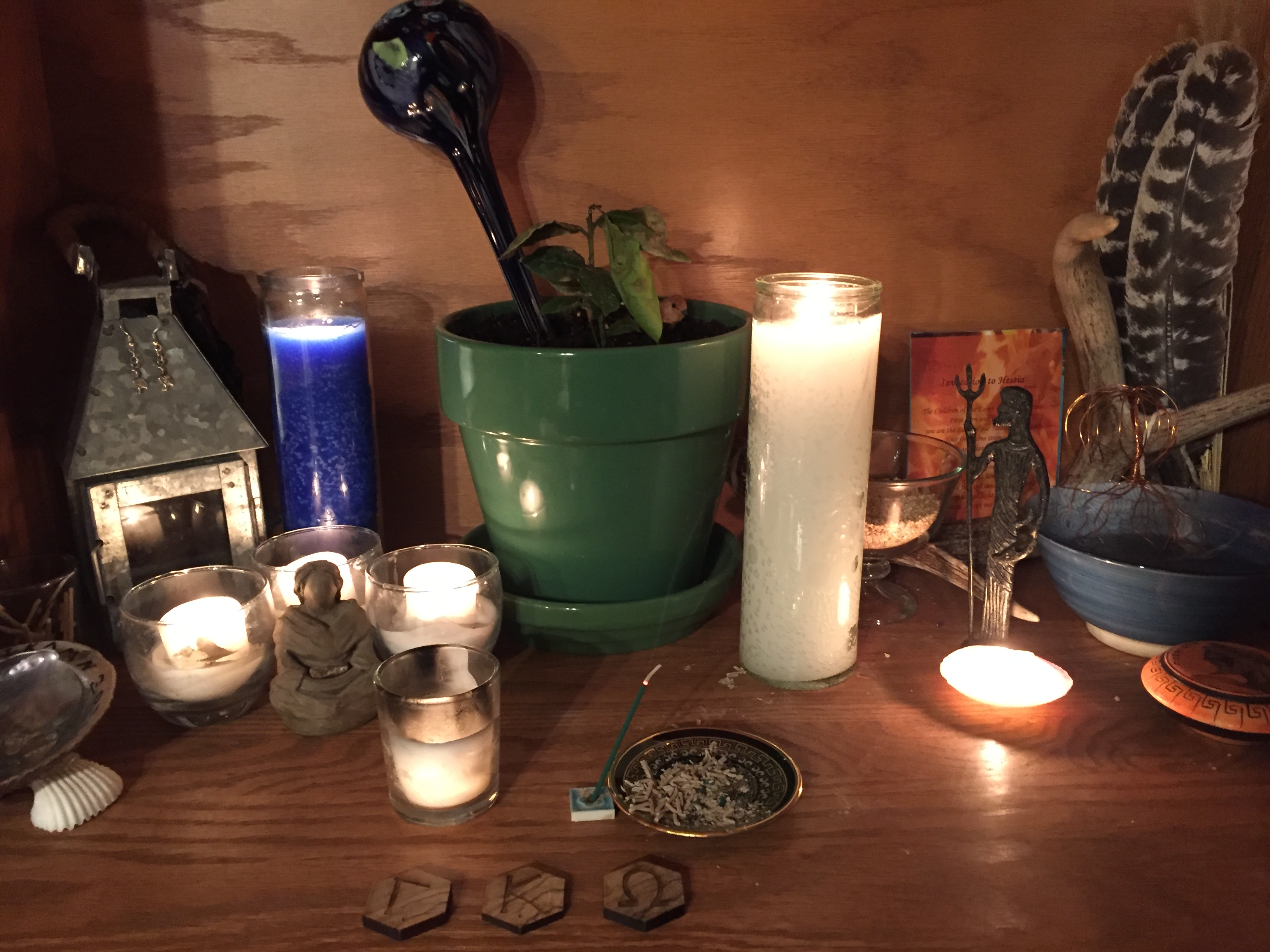
One of the cool things about the Dedicant Path, it that because it is a Path, you can always walk it. I recently decided to revisit the Home Shrine essay, especially since we moved earlier this year, and it gave me a chance to really re-evaluate what components of my altar I feel are most essential. These were the last things I packed up, and the first things I got out. I’ve since settled, and have my altar completely set up again, in the heart of our home. Below is a recent picture of my altar, and my revisited essay:

Home Shrine
My home shrine seems to always have minor changes happening, based partly on the seasons, and partly on whatever work I’m currently doing (since I tend more towards working altar than shrine). Since we moved this year, I had the benefit of getting to completely reset it up. In our new house it is set into the kitchen wall, where the microwave is expected to go. I like it there a lot, since it’s in a prominent place in our home, where I have easy access to it every day. It is also nice that it is at just the right height for me, and because of the counter-top, my daughter can sit there when she joins me for prayers.

The things that stay consistently on my shrine are a small Hestia statue and her flame, a Poseidon statue, an Artemis plate that catches the ash from the burning incense, an offering bowl, and my Well and Tree/omphalos representations. Other things that rotate in and out of my shrine are a water scrying dish, my Greek Alphabet Oracle set, a lantern to house Hestia’s flame, a live plant, an antler and feathers, Crane representations, various candles, written prayers, and a request for healing list. Additionally, my stole and my initiate cords are always within easily reach of my altar.

I do have various nooks around the house that have small shrines set up, but aren’t part of my primary altar. One of these that is fairly permanent is an Ancestor shrine (this includes the Grove’s Ancestor Box when I’m tending it). I would like to eventually get the shelves in my bedroom back up, which would allow me to move my altar there. Though honestly, at this point, I’m not certain I will. I like having it in the middle of the house where my family can join me easily.

Reconnecting: A Prayer to Begin Again

Sometimes when we’re trying to build a practice, we end up forgetting. Forgetting to honor our gods. Forgetting to honor our ancestors. Forgetting to honor the spirits around us.

And it can feel really, really hard to start back up again with whatever prayers and devotions you’d been doing or wanted to do.

But it’s okay. Everyone (I promise. Seriously, all of us) has had stretches of time where their devotional practice has fallen off. It’s okay. All you need to do is pick it back up again.

Your gods, your ancestors, the spirits all around. They’re just as interested in rebuilding that relationship as you. So start up again with your practice. This prayer can help.

Reconnecting Expiation

Have a prayer request of your own? Shoot me an email!

A Prayer on the Autumn Equinox

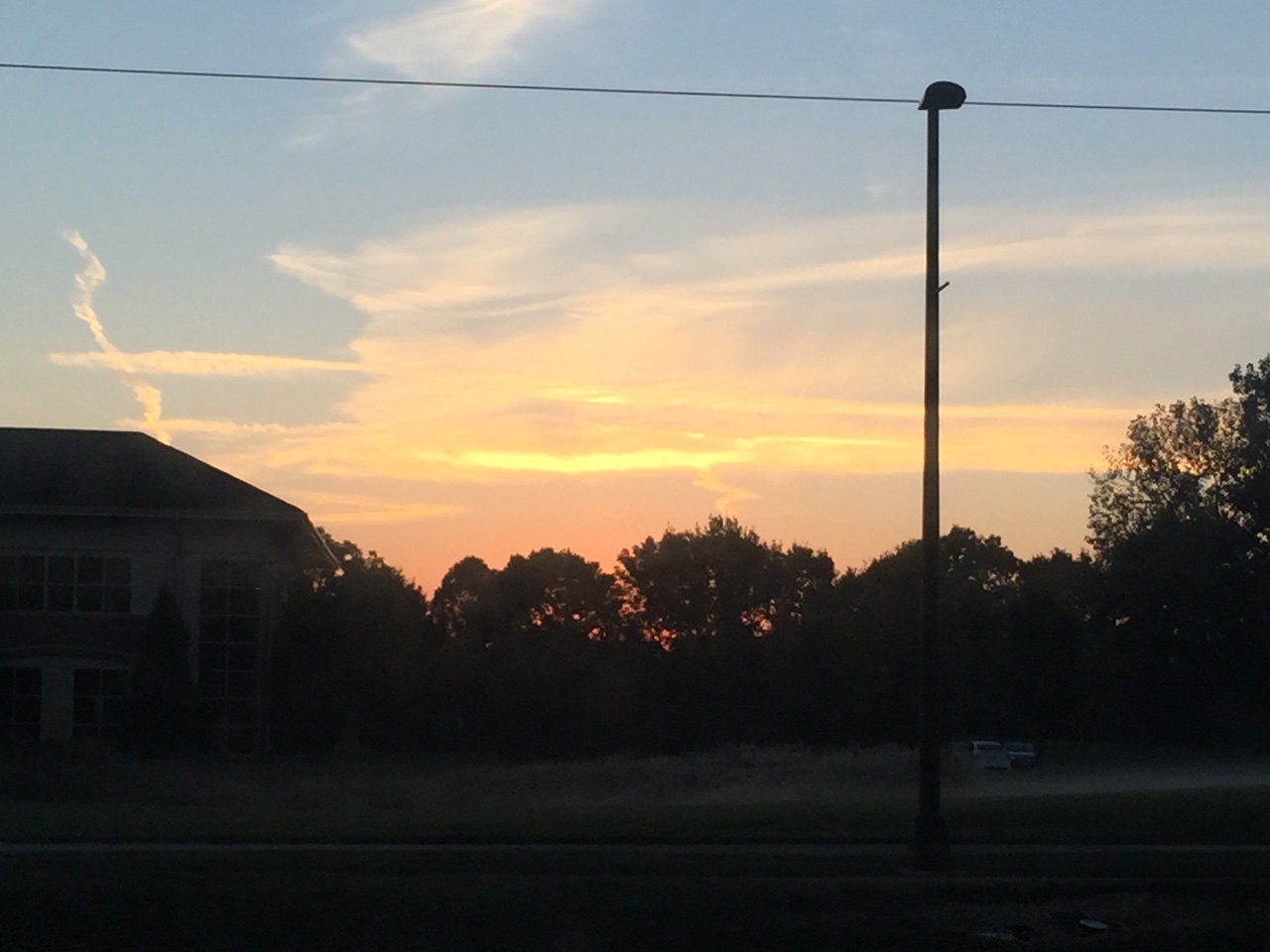
This morning, as I was sitting in the parking lot of my daughter’s daycare waiting for my carpool to arrive, I watched the sun come up.  Dawn is always a powerful time for me.  She is liminal in that space each day, opening the way from he darkness into the light.  She rekindles my spirit each morning as I watch her dance over the horizon to smile at the earth.

It is especially powerful to follow the progression of the sunrise and sunset.  As the days get longer and then shorter and then longer and then shorter, there is something magical in that.  It seems to happen so quickly, and yet not quickly at all.  There is normally less than a minute difference each day, and yet suddenly it seems like we’re waking up and going to work in the dark, and coming home as the sun is setting.  There is something powerful about that shifting balance between light and dark, about the Dawn herself.  Something powerful about knowing that even liminality is liminal and always shifting.

Au Eq Dawn

Dawn on the morning of the Autumn Equinox

The sun peeks her head above the horizon
On this day where the world hangs in balance.
Liminal in time and day,
A moment of transition where even liminality is in flux.
The dawn comes, never failing,
Even when the cycle shifts to darkness.
Blessed are the children of Earth
With Her to greet them each morning
No matter the day.
Blessed are the children of Earth,
Especially today as we mark
the beginning of the darkness
Yet still greeted with Her light.

Thoughts on Virtues and Ethics

As I’ve been reflecting on some of my Clergy Training Program work, one of the things that I have found to be extremely valuable these past 8 months or so was the work I did to examine what the values and ethics are in our society, and develop a personal code of ethics to help me navigate the work I do as a Priest. Since writing it, this Code of Ethics has continued to be useful to me and to my practice.  This is also part of the clergy continuing education, and is something that is required to be re-examined and re-evaluated at least once every three years, though honestly I expect I’ll be doing it more often than that. Reflection is a key part of this practice, and that commitment to continuing reflecting and re-evaluting my ethics may in fact be one of the things I add to my personal code of ethics when I revise it. Here is my Personal Code of Ethics as it stands today:

Personal Clergy Code of Ethics

  • “I will pray with the Good Fire” – I will maintain my own practice and my own relationship with the Kindreds. In this way I will have the fertile soil in which to grow into my role as a Priest.
  • “I will lead others to the Flame” – This is part of my Initiate Oath, and means that I will not hoard my knowledge or skills. I will be a good role model, guide, and teacher for all those who seek to walk the path of neo-paganism, and I will provide services relating to this path as much as I am able.
  • “I will be kind to others” – It costs me nothing to be kind to someone. My words and actions have the possibility of deeply affecting others, and my kindness may be the only bit of hope a person sees that day. I will also do what I am able to be sure that kindness is a priority in interactions that I observe and am part of.
  • “I will acknowledge growth” – This is two fold: I am constantly growing and as such should strive to continue learning. Others are also constantly growing, and I should allow in my perception of them that they are continuing to learn. I will not hold grudges.
  • “I will be an independent and responsible person” – I will be my own person, and determine my own actions. I will walk my walk, and not let others’ vision of me influence my path. I am responsible for my own actions, and will strive to remember that I am not responsible of the actions of others. I will also fulfill duties that make me a responsible member of society and the priesthood, especially as it relates to the law.
  • “I will be loyal and hold true to my word.” – When I make a commitment, those who are depending on me should be able to be certain that I will not back out, or that if I do it is for a very good reason. I will speak truth whenever possible, admit when I don’t know, and seek out those who do know. I will maintain the confidence of those who have trusted me to hold space with them.

When we write our Personal Code of Ethics for use as Clergy, one of the things we’re asked to look at is the Nine Virtues within ADF, as well what kinds of virtues exist within our society and how those two might play off each other. It is meant to give a starting point in developing our own ethics. The Nine Virtues in ADF are Wisdom, Piety, Vision, Courage, Integrity, Perseverance, Moderation, Hospitality, and Fertility. In addition to the Nine Virtues, other ethical codes that have influenced my own code of ethics in particular are The Delphic Maxims and The Hippocratic Oath. Throughout all these virtues and ethical codes are values that can be seen woven through the fabric of our society. So, where do the values in our society come from and how do they relate to these ADF Nine Virtues and other ethical codes?

Our society places value on wisdom, and as a culture we encourage people to seek out those who have gained wisdom through their life experiences. However, as a Millennial it is also encouraged to seek wisdom from less established sources, and instead seek wisdom through personal experience gained by risk-taking and creative problem solving. I seek to have wisdom by sharing the knowledge I have gained, and thus providing others with the opportunity to share in that wisdom.

Seeking wisdom through personal experience, risk-taking, and creative problem solving also relates to the virtue of vision. We value the ability to see the bigger picture, and plan out ways to make that dream a reality. I have goals, and in order to see those goals come to fruition I am acknowledging that there is always room for growth, and that there is always room for improvement.

This personal experience, risk-taking, and creative problem solving also relates in part to the virtue of fertility. We like to encourage freethinkers and those with creative minds. Fertility really sums up this focus I have on growth and my dedication to continue growing, both as a person and as a Priest, as well as my dedication to helping others grow and acknowledging that they are always growing and changing.

There is value placed on piety in our society, though in ADF we define piety based on the actions we take in our religion, rather than a certain set of ascribed beliefs. For me this is the act of prayer and maintaining my relationship with the Kindreds. It is also important for me to continue in my personal religious practices both for my own piety, but also so that I have integrity when I am discussing those practices with others, and not be disingenuous whether I’m writing liturgy, counseling others, or performing rituals

Integrity can be summed up in the famous line from Hamlet: “To thine own self be true.” From the Delphic Maxims, one of the most well known is maxim #8: “Know Thyself.” If we are in tune with who we are and what we desire we have the ability to begin to sort out what our ethics are, and how to live with integrity in our own lives. I’ve had to examine myself in order to write this Code of Ethics in the first place, and when I consider how I will be an independent person, I need to first have a good idea of who that independent person is.

In America integrity seems to be particularly valued. That attempt to walk to the beat of your own drum and not to let others define who you are. This in and of itself is often something that takes courage. Henry David Thoreau said “If a man does not keep pace with his companions, perhaps it is because he hears a different drummer. Let him step to the music which he hears, however measured or far away.” We have a history of self-reliance and a certain flair for independence as well as take pride in our ability (and right) to be ourselves.

This integrity is something that often takes both wisdom and courage. It takes wisdom to know what path I should walk, and wisdom to examine my own values and how they apply to my path. It takes courage to be independent and walk my walk. It can also take courage to hold true to my word when I may be pressured to do otherwise.

Perseverance can be seen alongside integrity and courage. In determining who I am, I will need to persevere in order to maintain that sense of self despite any obstacles I may encounter. I will need to persevere in continuing my path of growth and in continuing to challenge myself.

There is a huge precedence for the value of perseverance in America. In is contained in the preamble to the Declaration of Independence that we are each entitled to “the pursuit of happiness.” There are stories, myths, and legends about people in America who came here with nothing and through their perseverance built a life for themselves and became rich an famous. The concept of pulling oneself up by the bootstraps is widely known, and generally hugely valued.

Moderation is also something that is valued here, though it seems to be a value that has a variable degree of implementation. One can be moderate in things from drugs and drinking, to consumerism, to sex. We tend to see a lot a press given to enforce the idea of moderation as it relates to puritan ideals such as abstaining from drinking, drugs, and sex. This contrasts sharply with the other part of the virtue of fertility. However, there is less social pressure put on those who engage in rampant consumerism, and in some cases, society even seems to encourage this lack of moderation. For me in my personal code of ethics, I will strive to moderate my behavior to reflect my ethics.

The last virtue, hospitality, is encouraged in our culture, but it seems a bit more one-sided that the value placed on in in the context of ADF and the *ghosti relationship. Hospitality is a guest-host relationship, and each party has duties to hold to. In American society the host often seems to have more duties and the guest less. Think of parties you’ve attended where many of the guests leave without picking up after themselves, or family gatherings where someone always seems to overstay their welcome. For me, a lot of the idea of hospitality, of *ghosti, of kharis boils down to kindness. Being kind to others in as many ways as possible is a way of building relationship, and building the trust necessary to have a good relationship.

Relationships. That can sum up my approach to my spirituality and religion fairly succinctly. It is all about relationships, whether that is between two or more people, two or more groups, a person and the Kindreds, or any other collection of people and spirits. We build these relationships based on reciprocity and mutual benefit. My personal code of ethics allows me to be sure I’m staying true to myself in my actions and interactions with others. And reflecting on and re-evaluating my code of ethics on a regular basis will help me both maintain knowledge of my ethical conduct and allow me to see if there are parts that need to be added or removed to better maintain myself and my relationships with others.

Raising Pagan Children

I’ve always intended on raising my children pagan, and over the past two years, as I’ve been putting that desire into practice, for the most part, it has not been a conscious effort. There are a few things that I try to teach my daughter, and a few things that I specifically explain to her, but mostly it is just involving her, and being surprised at how much she picks up. I walk my path unashamedly, and so she see all the little parts of my life where my faith and my practice are incorporated.  Toddlers are sponges.

She sees me pray each morning, and now fairly consistently asks “Mommy, pray?” So we pray together when she asks. I call out to Hestia and light her flame and some incense, and then we say “Yay, Hestia!” I’ve started adding in a super short prayer to the Three Kindreds and showing her how to make an offering of grain. For her, it’s still mostly about getting to take a handful of stuff and dump it out, but she’s learning: now she waits while I speak, grain in one hand, and both hands cupped up to the sky like me, and then puts it in the bowl when I’m done speaking and we say “Yay, Kindreds!” Recently I’ve been teaching her some common phrasing we use in our grove. She can say “Good Fire” when you ask her how we pray. When you ask her who guides us, she’ll say “Garanus.”

Garanus Crane

Garanus Crane

She watches me when I do full COoR rites, and mimics my motions. Not only does she put her arms down for the Ancestors, out for the Nature Spirits, and up for the Shining Ones, she also mimics my spiraling motions when I open and close the Gates. This was most obvious when I was holding her during our Samhain ritual last year, and she made the motions with me as I opened the Gates.

She has started breathing with me during meditation. I’ve been trying to incorporate it into our bedtime routine. We “sit quiet” and breathe. It’s kind of cute, since she knows we’re breathing, and so she breathes in really loud, and then blows out. She’s made it about as long as a minute, though more often it’s around 30 sec, so we’re working on it.

There are other aspects to my path and my practice. I play guitar and music is important to me on a spiritual level. She watches me play guitar, and I’ve been encouraging her to drum along with me. I plan on getting her a ukulele in the near future so that she can play with me on an instrument that will grow with her.

Being outside and reveling in nature is important to me as well, so when we go on walks, and she gifts me with leaves, and pinecones, and rocks, and bits of flowers and grass, I take interest in those, and sometimes we talk about how it’s important to thank nature for giving us those gifts. We watch the rain and look at ponds and jump in puddles. We watch the clouds and how the sun reflects off them, and sometimes she’s up with me to watch the sun come up and pray to Ushas. She pets trees and says “Nice tree.” Nature is good; nature is very good.

So, in raising a pagan kid, for me, it’s mostly about involving her in my practice wherever I can, and when she shows speicifc interest, deliberately welcoming her in. It makes her happy to be involved and valued in things that are important to our family, and teaches her this practice and way of life. And it makes me happy to have a child who is interested in what I value, and happy to take part in these aspects of our life.