“A Voice at The Fire: Invitations To The Spirits” Workshop Outline

“A Voice at The Fire: Invitations To The Spirits”

Speaking Praise Offerings and Invitations to the Three Kindreds is a vital part of our practice as Druids and pagans.  In this writing workshop learn to craft your own invitations to the Kindreds for use in your personal practice, or in small group ritual.  We will work with descriptive language, poetic forms, and other literary devices when writing.  The workshop will conclude with a short blessing ritual where each person will have the opportunity to take the invitation they have written, speak it before the fire and the spirits, and make offerings.
The full workshop may be viewed on the Three Cranes Grove, ADF YouTube Channel:

 Workshop Notes:

Writing Invitations to the Kindreds

  • Invocation – Beings Within (think “Drawing Down” and “Horsing”)
  • Evocation – Beings Without (Inviting to be present at the ritual)

Memorize bookends & formulas if possible

Hey, you’re a god!

Here’s why you’re awesome!

We’re honoring you on this day.

Here’s your offering.

It’s appropriate to give to you for this celebration because Reasons.

Here’s how it is given to you and how you receive it.

Yay, god! Take your gift!

Types of Prayers:

  • Praise
  • Petitions
  • Love
  • Focus
  • Thanks
  • Forgiveness

Types of Rituals:

  • Solitary (1) -private
  • Small Group (2-10) – intimate; everyone knows what’s going on; everyone welcome to speak
  • Medium Group (11-30)– some may be unfamiliar with what is going on; most people still welcome to speak
  • Large Group (31+) – many may be unfamiliar with what is going on; speaking parts generally scripted; praise offerings welcomed, but perhaps not in verbal form
  • Extra Large Group (70+) – celebrants guiding/leading; may be the only ones who are speaking or know what’s going on; praise offerings sometimes welcomed, rarely in verbal form

Literary Devices & Descriptive Language:

Excellent book is Writing With Stardust by Liam O’Flynn

  • Active verbs
  • 3×3 descriptions
  • epithets
  • extended metaphor
  • parallel structure

Write Your Own:


Activity

Short Devotional:

Full COoR; parts divided amongst participants

The *ghosti of Our Own Druidry

Five Gifts

Reciprocity is an essential component to walking the path of Our Own Druidry.  This is familiar to many of us in the context of ritual: we give gifts to the Spirits that we may build a relationship with them, and receive their gifts in turn.  This relationship of reciprocity is also important in how we interact with each other and with our community as a whole.  A healthy community is supported by the gifts of its folk so that it may then support each of those individuals.  There are many ways to engage in this *ghosti relationship.  Many ways to give, and many ways to receive.  We can give the Gift of Prayer.  We can give the Gift of Inspiration.  We can give the Gift of Community.  We can give the Gift of Wealth.  We can give the Gift of Service.  The more we strive to share these Gifts, the stronger our community will grow, and the more fulfilled we will be in Our Own Druidry.

The Gift of PrayerRta.  We maintain right action and right relationship with the Gods and Spirits.  It is important work to ensure that the proper sacrifices are made at the proper times.  We write liturgy and lead rituals.  We know the cycles and seasons, and we keep the High Days.  We pray on behalf of those who need and request it. When we commune with the Kindreds and engage in a *ghosti relationship with them, we are giving the Gift of Prayer and upholding the Work and Vision of Ár nDraíocht Féin.

The Gift of Inspiration– Lead others to the flame.  We give workshops and create teaching materials.  We do community outreach and explain our beliefs to the curious.  We welcome those seekers of the Old Ways into our path.  When we ignite the fire within others that they may walk the path of Our Own Druidry, we are giving the Gift of Inspiration and brightening the Work and Vision of Ár nDraíocht Féin.

The Gift of Community – One fire.  One hearth.  Our community with each other is what makes us strong.  We embody the spirit of Hospitality.  We can give the gift of community by being present and thoughtful in our online pagan communities, by attending and participating in our local pagan communities, and by being a listening ear and a sounding board to others in our community.  When we are consistently present in the lives of those practicing Our Own Druidry, we are giving the Gift of Community and being part of the Work and Vision of Ár nDraíocht Féin.

The Gift of Wealth – Wealth that is hoarded is not wealth at all.  This is a common theme across our Indo-European Hearth Cultures.  When we give of our wealth, our tangible resources, we are manifesting the essence of “movable wealth.”  Do ut des.  “I give so that you may give” means that as we give in support of our community, they in turn will be able to give in support of us.  When we give of our monetary resources, we are giving the Gift of Wealth and supporting the Work and Vision of Ár nDraíocht Féin.

The Gift of Service– Everyone in ADF is an expert at something.  Everyone has a talent or skill that can benefit others.  Sharing our special knowledge and our time is something that everyone can do.  There are many tasks in the work of Our Own Druidry that just require someone to donate their time, or their specific skill set, to see a task through.  We help set-up and tear-down ritual space.  We organize potlucks and take dishes home to wash.  We schedule and attend meetings.  We hold an office in a grove or subgroup.  We review coursework.  When we share our talents and our time, we are giving the Gift of Service and contributing to the Work and Vision of Ár nDraíocht Féin.

Five Gifts: Prayer, Inspiration, Community, Wealth, and Service.  These are ways that we can give of ourselves to support the Work and Vision of Ár nDraíocht Féin.  In sharing these things we will find that we are given great blessings in return as our community is strengthened, we are valued and supported, and the path of Our Own Druidry is brightened.

Theater for Ritual 1

1) Describe the origins of theatre and how it relates to ritual in at least one ancient Indo-European culture. (300 words minimum)

We don’t have too much direct evidence of early theater, but from what sources remain, mainly wall paintings and other artifacts, we can surmise that theater began as a way to relate events and stories that the culture considered important to preserve.  The relation of stories and events was cyclical in ancient cultures, and as the actions of the storytellers, or ritualists, were carried out, so was the actual act within our world manifested.  Thus, these ceremonies where experiences were related were also a way of making sure those experiences would happen, such with a hunting ritual echoing the desired outcome of the hunt.  “These actions moved from habit, to tradition, and then on to ceremony and ritual.” Then, as ritual and theater became entwined, as the ceremonies and stories began to be valued for their entertainment, and as the rehearsal and repetition of the stories continued to grow, they moved more towards what we see as the basis for modern theater, as seen in Ancient Greece and other Indo-European cultures (Robinson).


Within Ancient Greece, theater, ritual, and myth were well entwined, and drama itself became a way to honor Dionysos, one of the Greek gods, particularly during Dionysia ta astika, the City Dionysia.  During this festival one of the big things that would happen was a competition of various dramatic works.  It should be noted that the temple for Dionysos in Athens was within the theater precinct, indicating a distinct overlap in the use of theater and ritual.  The plays that were performed “were never secular entertainment but always taught piety, morality and moderation, and the comedies afforded the poet a chance to make political statements that might not otherwise have been tolerated” (M, Sean). Interestingly, this was a festival that foreigners, outsiders, were able to take part in, whereas many of the civic celebrations in Ancient Greece were reserved for citizens and their families.  Civic religion in Ancient Greece was notably separated from household worship, but in the case of ritual, the civic festivals contained elements of theater so that they would be accessible to all citizens within the city.  The ritual honoring Dionysos came first, and was only later that this became an event more focused on entertainment, and thus, theater. We see this in the festivals like Dionysian ta astika where the entertainment that grew out of them was informed by the rituals that were their foundation.


2) Explain “intentional movement” and why it is important in ritual. Include how movement can both aid and detract from the ritual experience. (100 words minimum)

Intentional movement in the context of ritual is when all movements, from small gestures to full body movement, are performed with intent and focus.  This means that when you gesture in ritual you only do so if it’s necessary, and you make the movement complete, rather than half-attempted, or half-hearted.  This lends confidence and authority to your speech and any magical actions you may be making, and helps the audience focus on your words and better direct their own energy to the task at hand. It can also help solidify the look of a ritual, and get all celebrant and ritualists in the same headspace, if all celebrants are making the same gestures and motions.   For example, if you include a gesture when praying to the Shining Ones, such as raising your arms, raise them completely into position, and be willing and able to hold that position for the whole invocation.  Don’t be surprised if many of the other celebrants and Folk copy your motions. Likewise, when you move in ritual, you should only move when necessary to get from point A to point B, such as to make an offering or take the Waters around to the Folk.  When gesture and movement are not intentional, this has a number of effects, including making the ritual and ritualist look unpolished and unsure of themselves, as well as distracting the Folk gathered and thus disrupting the flow of energy in the ritual (Thomas “Well Trained Ritualist”).


3) Explain your understanding of the circles of concentration. (200 words minimum)

The Circles of Concentration, as Rev. Thomas describes, are about finding a focus in ritual in order to both lead and experience a better ritual in terms of energy and logistics.  There are four circles that exist in a ritual with more than one or two people.  The first circle encompasses the self.  The focus on this level is all about your own awareness (where you are, what you’re saying, etc.), and being able to continue to act without giving in to the critic that is babbling away in the back of your mind about all the things you might be doing wrong.  I would also say that the focus on the self in this first circle is important to maintain the self, especially in the face of doing intense trance or magical work, where the boundaries between what is you, and what is another may blur (Thomas “Circles of Concentration”).

The second circle encompasses not only the self, but also the other celebrants in the rite.  The focus on this level is about staying aware of the other celebrants for logistical purposes, but also feeling connected to them on an energetic level so that you are able to work in harmony with each other.  This harmony between all the celebrants leads to a more fulfilling rite both amongst themselves, and for the ritual attendees (Thomas “Circles of Concentration”).

Which brings us to the third circle, which encompasses not only the self and the other celebrants, but also the Folk.  The focus on this level is about being attuned to the Folk.  Can they hear? Can they see? Are they engaged?  This is the circle that I often refer to as the “Bardic Lasso.”  When I am acting in the role of Bard for a rite, it is not simply the person who brings the lyrics to pass out and leads the songs.  The Bard is the person who is intimately aware of the energy level and engagement of the Folk, and helps to hold everyone together in the ritual, and bring the energy level up and down as needed throughout the rite (Thomas “Circles of Concentration”).

The fourth circle encompasses not only all the human players at a rite, but also the otherworldly participants, the spirits.  The focus on this level is where the purpose of the rite often is: feeling a connection with the spirits.  A strong fourth circle will allow the celebrant to effectively call to a spirit, and as they see the spirit approach, because they are still connected to the second and third circles, so too will the other celebrants and the Folk.  This allows everyone present at the ritual to feel that connection (Thomas “Circles of Concentration”).


4) Describe the advantages and disadvantages of the three ritual configurations (proscenium, thrust, and round). Note how a ritualist can maximize the advantages and minimize the disadvantages of each configuration. Offer at least one type of ritual that would work best in each configuration. (100 words min. for each configuration)

The three types of ritual configurations are proscenium, thrust, and round.  There are advantages and disadvantages to each configuration.

A proscenium configuration is where the audience is arranged in rows facing a (often raised) stage.  This is the configuration that Three Cranes Grove uses in our Dublin Irish Festival Lughnassadh Rite, which typically draws between 300 and 400 people.  Some advantages that make this the configuration that makes the most sense, particularly for this ritual, are that the majority of the audience has no problem seeing the celebrants, and since we are mic’ed, hearing us as well.  Some disadvantages to this configuration are the possibility of being accidentally upstaged by another celebrant who is onstage as they move or fidget, as well as the distance from the celebrants to the audience lessening the energy flow between the two and a decrease in the interactiveness on the part of the audience.  Another disadvantage that we’ve had to account for by having rehearsals is the stage size and amount of celebrants with speaking parts.  When the stage is small, only so many people can be active celebrants in order to minimize time between parts.  We also have to rehearse movement and blocking so that everyone knows where they should be, and how to get from Point A to Point B when they have to move (Thomas “Well Trained Ritualist”).

A thrust configuration is where three sides of the ritual space have audience members, and the altar typically takes up the fourth side, pushed slightly forward.  This is the configuration we use for the vast majority of our public rituals in Three Cranes Grove.  One advantage is that when a celebrant has to speak they can put their back either to the altar or to the fourth side, so that no audience members are behind them.  We often stand in front of the altar for all speaking parts that don’t requiring working at the altar, such as taking the Omen or working the Return Flow.  This could be a disadvantage, and does require awareness on the part of the speaking celebrant that they don’t turn to make an offering as they are still speaking because this turns their back to a portion of the audience while they are still talking, and thus those people can’t easily hear them.  There is also the advantage to this configuration as it relates to energy flow and participation of the audience.  The audience can feel a part of the action (Thomas “Well Trained Ritualist”).

A round configuration is where the action and speaking all happens within the center of a circle (or egg shape, as a lot of our “rounds” end up being).  This is the configuration we use in a lot of the semi-public and private rituals, such as members-only Druid Moon rites, at Three Cranes Grove.  When we set up this space it is most often outside, and the fire is at the center.  If we have a more formal altar, it is either at the center near the fire or off to one side of the ritual space.  Because this space has a lot of disadvantages as far as the audience being able to effectively hear or see what is going on, we rarely use it for larger rites, and try to stick to rite where all the audience members are intimately familiar with the ritual structure and often will all have some part that requires participation as well. The advantages we experience using this space is that each person is a part of the action, and in these smaller rites, folks can make personal offerings to the Kindreds from all sides of the fire without the awkwardness that often happens with folks waiting in line to approach the fire.  I find this configuration is also extremely useful in magical work because the energy flow is so much better.  The person who is leading the magical working stands at the center to direct (both the folk and the energy), making sure to turn their head and body as needed so all in the circle can see and hear (Thomas “Well Trained Ritualist”).


5) Choose a being of the occasion appropriate to a specific high day of your choosing and describe a theatrical method of conveying the mythology of that being to others during a public performance. (300 words minimum)

For Three Cranes Grove Spring Equinox Rite in 2015, we chose to honor the Vedic Gods, specifically Indra.  Indra is a Thunder-God, and the being that won the Waters for the Folk in Vedic Lore.  We get many spring thunderstorms in Central Ohio (along with the occasional tornado, derecho, and general rainy weather), and as such Indra seemed like a deity that many could find a connection with, even if they did not follow the Vedic Gods in particular.  The story of Winning the Waters is one that is not only common across Indo-European cultures, but also essential to our understanding of the Waters of Life within ADF.  This meant that the Folk were already familiar with the idea of these Blessed Waters being given to us by the Shining Ones, and that they could make connections of that winning of Waters to their own gods.

Because we’ve been working on incorporating children’s programming into every ritual, and because the Vedic mythology is not something that many in our community are familiar with (most leaning Celtic or Norse in their practice), this was an excellent opportunity to tell this story in a way that involved the children of our Grove as well as was easily understandable by all attendees.  To this end I wrote a short play with three main parts, and a selection of other less involved or optional parts, to tell the story of Indra winning the Waters during the Return Flow section of the ritual. I kept the lexile (reading level) of the play low in order to help the children learn their lines and to make it easier for everyone to understand.  I referred to the Rig Veda (1.32) when writing the text in order to pull lore-specific imagery in to the text.  (I have included the text of the playlet below.)

The ritual was performed in the thrust configuration, and thus so was the play itself.  The audience was arrayed in a general arch shape around the altar and the performers.  This made it fairly easy for everyone to see and hear, though we did have to account for some rather strong winds, and make an extra effort to speak loudly and clearly.  The part of Indra and Vrtra were played by two of our older children, and they rehearsed their lines beforehand, and were quite confident.  I was the officiant for this ritual, and employed the Circle of Concentration in this role.  It was imperative, particularly because not only was I telling the story, but I was also working the magic for the Return Flow.  Thus, I was aware of myself in my speaking role, aware of the children performing alongside me, aware of the folk watching the ritual, and aware (very keenly) of Indra as the Waters were infused with the blessings we received.  It took a lot of concentration and a lot of energy to be able to old all of that energy and focus together, but I also felt it worked extremely well for relating the mythology of Indra winning the Waters and performing the magic of the Return Flow.

“Indra Wins the Waters”

This playlet was written for the children’s programming for Three Cranes Grove 2015 Spring Equinox Ritual honoring Indra.

 Lexile: 680L (late 3rd grade, early 4th grade reading level)

Cast:

OFFICIANT: The person who is doing the Return Flow portion of the Ritual

INDRA: The Vedic Storm God

VRTRA: The Dragon

CELEBRANTS: The folk at the ritual

STORM-BRINGERS: sounds of the storm (can be the same as the CELEBRANTS if needed)

Optional Cast:

DRAGONS: Vrtra’s family

SACRED COWS: to represent the Waters and Blessings

*following the Seer’s pronouncement of a positive Omen*

OFFICIANT: These are indeed good omens.

OFFICIANT: But you should know that until Indra won the Waters for us, we could not have received these blessings because Vrtra the Dragon hoarded them all for himself and his family.

OFFICIANT: Here is Vrtra now, and he is holding onto [omen], [omen], and [omen].

VRTRA: These gifts are mine! All mine!

OFFICIANT: But the people wanted the blessings too, and they knew only the mighty Indra could help them now.  So they called out with one voice: “Indra, Give us the Waters!”

CELEBRANTS: Indra! Give us the Waters!

OFFICIANT: Listen: Do you hear him coming?  Here comes Indra the Storm-Bringer!

*STORM-BRINGERS shake noisemakers as Indra enters the stage*

OFFICIANT: In the thundering clouds with his lightning bolt in hand, Indra demands:

INDRA: Vrtra! You have to share the blessings!

OFFICIANT: Vrtra roars mightily and retorts:

VRTRA: No! These gifts are mine! All mine!

OFFICIANT: And the people knew Vrtra was going to hold onto those gifts of [omen], [omen], and [omen] with all of his might.  So they again called out: “Indra! Give us the Waters!”

CELEBRANTS: Indra! Give us the Waters!

OFFICIANT: And Indra heard their plea and prepared to do whatever was necessary to win the waters for the people.  He again shouted to Vrtra:

INDRA: Vrtra! You have to share the blessings!

OFFICIANT: But Vrtra again roared his denial and shrieked:

VRTRA: No! These gifts are mine! All mine!

OFFICIANT: Indra grew angry that Vrtra wouldn’t share the blessings with everyone, and as his anger grew, so too did the sound of the storm.

*STORM-BRINGERS shake noisemakers*

OFFICIANT: The people knew now was the moment.  Now was the time to give Indra all their support.  And so they called out one final time: “Indra! Give us the Waters!”

CELEBRANTS: Indra! Give us the Waters!

OFFICIANT: The storm rumbled as Indra went into battle with the mighty Vrtra, his lightning bolt held high.  With a flash he struck down Vrtra with his lightning bolt.  The Dragon bellowed as he fell.

OFFICIANT: The waters, the blessings, the gifts were now free.  The mighty Indra won them away from Vrtra the Dragon and brought them to us.

*INDRA brings Waters to OFFICIANT*

OFFICIANT: These Waters are infused with the blessings of [omen], [omen], and [omen].  “Behold! The Waters of Life!”

OFFICIANT: As these Waters are poured out for each of us, remember how they were won for us, and how we sing the praises of the Storm God who won them.

OFFICIANT: See how the gifts of [omen], [omen], and [omen] can flow into our lives.  See how they can flow into our grove.  See how they can flow into our community.  See how you and the world can be renewed and rejuvenated by these Waters so courageously won and freely given.

OFFICIANT: Drink deep, Children of Earth, and be blessed!


6) Explain how you would prepare and deliver three of the following pieces for public performance, and include an audio or video clip of your performance of each. (50 words min. each explanation) 

Audio for all 3 pieces: https://youtu.be/g1Wum-1ukZ4

 a) Strong meter and strong rhythm: selection 1

Ye who love the haunts of Nature,

Love the sunshine of the meadow,

Love the shadow of the forest,

Love the wind among the branches,

And the rain-shower and the snow-storm,

And the rushing of great rivers

Through their palisades of pine-trees,

And the thunder in the mountains,

Whose innumerable echoes

Flap like eagles in their eyries;-

Listen to these wild traditions,

To this Song of Hiawatha!

When reading a text with strong meter and rhythm it is important to take note of the punctuation, and when delivering it, speak to the end of the punctuation, not just to the end of the line.  You must plan beats and word emphasis.  In this piece in particular, that means lines 6 to 7 and lines 9 to 10 should be read through without undue pause at the line break.  It is also important to note where there are literary devices that are included for emphasis in the poem, for example, the parallel structure in lines 2, 3, and 4 with “Love the…” and the alliteration in lines 6, 7, and 10 with “rushing…rivers”, “palisades…pine”, and “eagles…eyries”.

c) Complex thought with complex meter: selection 3

Context: Hamlet has discovered that his uncle murdered his father to gain the throne. Hamlet is wracked with indecision about how to avenge his father and has gone into a deep depression, which stifles any action he might take. In this speech he has just seen a Player enact an emotional scene about the death of Hecuba, queen of Troy.

O, what a rogue and peasant slave am I!

Is it not monstrous that this player here,

But in a fiction, in a dream of passion,

Could force his soul so to his own conceit

That from her working all his visage wann’d,

Tears in his eyes, distraction in’s aspect,

A broken voice, and his whole function suiting

With forms to his conceit? and all for nothing! For Hecuba!

What’s Hecuba to him, or he to Hecuba,

That he should weep for her? What would he do,

Had he the motive and the cue for passion

That I have? He would drown the stage with tears

And cleave the general ear with horrid speech,

Make mad the guilty and appall the free,

Confound the ignorant, and amaze indeed

The very faculties of eyes and ears. Yet I,

A dull and muddy-mettled rascal, peak,

Like John-a-dreams, unpregnant of my cause,

And can say nothing;

Again, it is important to take note of the punctuation, and when delivering it, speak to the end of the punctuation, not just to the end of the line.  Hamlet is speaking here in angst, not just in poetic meter.  It is also important to know the emotion that is meant to be conveyed in the text and relate that in voice and tone, as well as words spoken.  In this case, Hamlet in self-deprecating and indecisive, not sure what to do as he’s preoccupied still with his father’s death.

 d) Prose: selection 4

But Skadi, daughter of giant Thiassi, took helmet and mail-coat and all weapons of war and went to Asgard to avenge her father. But the Aesir offered her atonement and compensation, the first item of which was that she was to choose herself a husband out of the Aesir and choose by the feet and see nothing else of them. Then she saw one person’s feet that were exceptionally beautiful and said:

“I choose that one; there can be little that is ugly about Baldr.” But it was Niord of Noatun.

It was also in her terms of settlement that the Aesir were to do something that she thought they would not be able to do, that was to make her laugh. Then Loki did as follows: he tied a cord round the beard of a certain nanny-goat and the other end round his testicles, and they drew each other back and forth and both squealed loudly. Then Loki let himself drop into Skadi’s lap, and she laughed. Then the atonement with her on the part of the Aesir was complete.

It is said that Odin, as compensation for her, did this: he took Thiassi’s eyes and threw them up into the sky and out of them made two stars.

In this one, it is again important to note what the emotion is in the story.  In this case, there are points of the story that are humorous, and so knowing where that humor is, and acknowledging it with your facial expressions, is important in conveying it.  I also had to check pronunciation on a few of the names in this one (Thiassi and Noatun), being unfamiliar with them.  Generally, this means that I needed to work on speaking through them with confidence.


7) Write a statement of purpose for a rite of your choosing and one invitation for each of the Three Kindreds. Submit a video (of no more than ten minutes of total length) of your performance of all four pieces.

Hellenic Full Moon Rite Statement of Purpose: https://youtu.be/xXOxwc6NJko

O Makares, Blessed Ones,

I call out to you on this night of the full moon,

As it grows in power, ever luminescent.


We come to you each month

As the moon waxes and wanes

marking this time as sacred

and this place as sacred.


We come now to makes offerings

as our ancestors did before.

To reforge the sacred *ghosti bond.


Be welcome Theoi

and join us in our rite.


Ancestors: https://youtu.be/qgcf2vBUPoA

The Children of the Earth call out to the Ancestors!

Those of our blood and our bone,

Those of our heart and your hearth,

Those of our friends and our folk.


We call out to those Mighty Dead and Ancient Wise

Poets and Priests

Those who have walked this path before us

and have use the way

Ancestors, Mighty Dead,

Accept our offering.


Nature Spirits: https://youtu.be/t_C_BeAqk0E

The Children of the Earth call out to the Nature Spirits,

Those Beings who swim and crawl and wriggle and fly.

All the beings of the this Earth wherever they may come from.

Those who dwell in light and those who dwell in shadow,

Seen and unseen.


Natures Spirits:

Animal friends, Mineral friends,

Plant kin and Earth kin.

You who walk with us in all that we do

showing us the ways that we might honor the gods.

Nature Spirits, we honor you.


Shining Ones: https://youtu.be/t91JWEnaCPc

The Children of the Earth call out to the Shining Ones:

Bright and Mighty Theoi!

You who are the first children of the Mother,

Eldest and brightest.


You of craft-folk, you of grain,

you of hearth, you of sea, you of land.

Hunter, gatherers,

forge-tenders, grain guarders.


Gods and Goddesses all:

We call out to you as you share your wisdom and your love.

Shining Ones, accept our offering!


Works Cited

Griffith, Ralph T.H. Rig Veda. Sacred Texts, 1896. Web. 8 Jan. 2015. <http://www.sacred-texts.com/hin/rigveda/&gt;.

M, Sean. “Dionysia Ta Astika.” Temenos. Hellenion, 8 Nov. 2008. Web. 09 Nov. 2015. <https://sites.google.com/site/hellenionstemenos/Home/festivals/dionysia-ta-astika&gt;.

Robinson, Scott R. “Origins of Theatre.” Origins of Theatre. Central Washington University, 2010. Web. 09 Nov. 2015. <http://www.cwu.edu/~robinsos/ppages/resources/Theatre_History/Theahis_1.html&gt;.

Thomas, Kirk. “Concentration in Ritual.” Ár nDraíocht Féin: A Druid Fellowship. ADF, December 22, 2009. PDF file. 03 Jan. 2016. <https://www.adf.org/system/files/public/rituals/explanations/Concentration-In-Ritual.pdf&gt;.

Thomas, Kirk. “The Well-Trained Ritualist” Ár nDraíocht Féin: A Druid Fellowship. ADF, November 19, 2009. PDF file. 03 Jan. 2016. <https://www.adf.org/system/files/public/rituals/explanations/Well-Trained-Ritualist.pdf&gt;.


Let this Victory of Love Rejuvenate us!

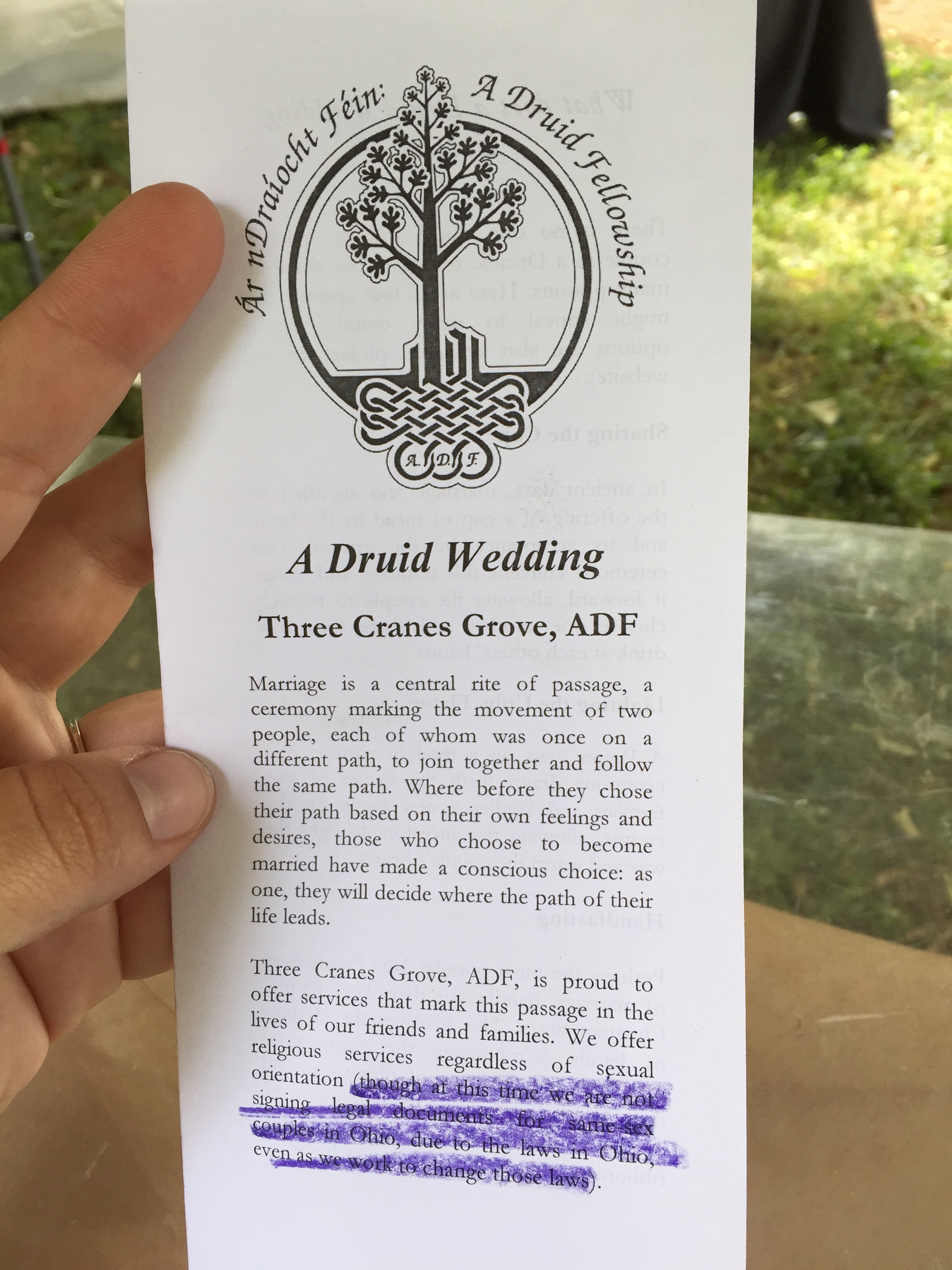
I took great pleasure in updating the Druid Wedding fliers for Three Cranes Grove, ADF this morning!


Let us celebrate this great victory: revel and take resounding joy as love wins.

And amidst the celebration, let us remember to take this joy and this energy we’ve been given, the rejuvenation and reigniting of our spirits, and continue to fight for those who still lack protections and rights under the law. For those who identify as bi, trans, queer, pan, poly, or any other orientation that does not have the same visibility and same rights that we are currently celebrating: we see you! And the fight continues until ALL love wins!

So celebrate! And let your spirit be reinvigorated for the continued fight ahead!

Brightest Blessings on us all!

~Rev. Jan Avende

Wisteria Summer Solstice 2015 – Closing Rite

This year at Wisteria Summer Solstice, Three Cranes Grove, ADF was again asked to lead several rituals throughout the festival. We did the opening rite, the main summer solstice rite, and the closing rite. We were asked to tie all three rituals together. The theme of the festival this year was “Weaving Deeper Roots.” The Opening and Closing both take more of a devotional format, and the Main Summer Solstice Rite follows the ADF Core Order of Ritual. I had the pleasure of writing the liturgy and leading these rituals with my grove mates. Here is the script for the Closing Rite:

Statement of Purpose
Well, we’ve made it through a wonderful festival weekend, and in spite of the torrential rains, we’ve grown closer as a community. Perhaps even in part due to the weather. It’s important to remember that even as the rain pounds down, it nourishes the Earth, it nourishes the Land, and it nourishes us. Even as we are soaked to the bone, it drives us closer together. We seek shelter together and our roots grow stronger.

Now, as the sun has returned in full Solstice force today, the Waters we’ve gained are warmed within us and across the Land. Breath deep, and take a moment to feel the Waters within as the warmth of this Summer Solstice sun brightens in them and in you.

Restoration of the Ordinary
This Heart Fire was lit on Thursday from three Sacred Fires: The Fire of Fellowship, the Fire of Inspiration, and the Fire of Blessing. It has been tended by all of us: one Tribe, one Community, One Folk. From this Fire the other fires throughout the festival were lit and joined: PawPaw, Pirate’s Cove, the Stone Circle, and many others. All connected as one, helping us build fellowship, inspiring us, and filling us with the blessings of the spirits and our community. Those fires have been brought back to this Fire, the Heart Fire, that they may be joined together as one once more. Here at this Center they all burn. Here at this Center our roots meet and we are one.

It is now time to remember the connections we’ve made, and the ties we have deepened with our tribe, and to say goodbye for another year. Our roots have grown strong and we have danced around the fire with the Spirits. Now we thank them for joining us around this Good Fire and in our revelry this weekend.

Thanking the Spirits
Ancestors, the Children of the Earth call out to you!
Those of our blood and my bone, who have given us life.
Those of our heart and our hearth, who have guided our steps.
Those of our friends and our folk, who strengthen and deepen our relationships.
Those Mighty Dead: poets, priests, and bards.
Heroes among the ancestors who have shaped our world.
We joined in Fellowship this weekend, and remembered our roots.
We came together as one Tribe, one Community, one Folk,
and continued our observance of the Elder Ways.
For joining us, Ancestors, we make this offering to you in thanks.
May we continue to be guided by your wisdom and blessed by your presence in our lives.
Ancestors, we thank you!

Spirits of Nature, the Children of the Earth call out to you!
Those of fur and feather, who run and fly across the land.
Those of root and stem, who grow deep into the earth and reach for the sky.
Those of stone and mineral, who enrich the soil and enrich our lives.
Those Totems, Guides, and Allies, you who teach us your ways to love and honor the Earth.
We were inspired by you this weekend.
We supported each other as the rains fell, and raised our voices to the heavens in prayer and praise.
We came together as one Tribe, one Community, one Folk,
and continued our observance of the Elder Ways.
For joining us, Sprits of Nature, we make this offering to you in thanks.
May we continue to be guided by your wisdom and blessed by your presence in our lives.
Sprits of Nature, we thank you!

Shining Gods and Goddesses, the Children of the Earth call out to you!
Those of the Heavens, who shine brightly upon us and give us nourishing rains.
Those of the Land, who provide for us and walk beside us in our path.
Those of the Underworld, who care for our dead and know the riches of the earth.
Those Patrons, who take special interest in us and we worship with our heart, mind, and soul,
Devotees honoring you as you care for us.
We raised our arms, our branches, to the sky in unison and made offerings to you this weekend
and we received your Blessings in return.
We came together as one Tribe, one Community, one Folk,
and continued our observance of the Elder Ways.
For joining us, Shining Gods and Goddesses, we make this offering to you in thanks.
May we continue to be guided by your wisdom and blessed by your presence in our lives.
Shining Gods and Goddesses, we thank you!

Sending out the Heart Fire
The Three Kindreds, these many and varied and vibrant Spirits, we’ve now thanked for joining us this weekend in our revelry. Their roots have been woven into ours, and so now we’d like to make it so that we can all take a piece of this Fire home with us.

This is the heart fire of this festival. It has burned bright and strong here, and now, transferring it to these candles we send the Spirit of the Fire to live in these smaller flames.
In this Heart Fire lives the Heart of our Tribe, our Community, our Folk.
When we are missing our Tribe,
we can light this fire and reignite our Fellowship and reconnect our roots.
When we hear that one of our Tribe is hurting or in need of support,
we can light this fire and reignite our Fellowship and reconnect our roots.
When we need the inspiration of our Tribe,
we can light this fire and reignite our Fellowship and reconnect our roots.

So as this flame ignites your candle, let it also ignite in your heart. Feel the heat of the sun warm you as you hold this flame. Feel that warmth spread through you and the energy connect to the flame in your hand, the flame in your heart, and the flame in the Heart Fire here. Know that they are connected.

Dousing the Heart Fire
Now that we have this Heart Fire that we have tended burning in our own hearts, and have the ability to rekindle it for ourselves and each other, even in the darkest of times, the time has come to say goodbye for now, and douse these flames here.

So, even though the Fire may go out here, in this time and in this place, may it always burn ever strong within our hearts.

Go now in peace, carrying this Fire of Fellowship, Inspiration, and Blessing with you. Remember that we have woven our roots together as one Tribe, one Community, on Folk, and that we are all brightened by this same bright Fire.

Safe travels one and all as we journey on until we meet again!

Wisteria Summer Solstice 2015 – Opening Rite

This year at Wisteria Summer Solstice, Three Cranes Grove, ADF was again asked to lead several rituals throughout the festival. We did the opening rite, the main summer solstice rite, and the closing rite. We were asked to tie all three rituals together. The theme of the festival this year was “Weaving Deeper Roots.” The Opening and Closing both take more of a devotional format, and the Main Summer Solstice Rite follows the ADF Core Order of Ritual. I had the pleasure of writing the liturgy and leading these rituals with my grove mates. Here is the script for the Opening Rite:

Statement of Purpose
Welcome! We’re here to light the heart fire that will burn throughout the festival. This is a community flame. It is the hearth of our tribe, and it burns within us all. We gather together each year at this time when the sun rides high in the sky and shines brightly upon us all, filling us with the brightness and warmth of the summer sun.

Establishing Sacred Space
We are all Children of the Earth and here we weave out roots together. We may travel from all over, journeying through land, sea, and sky. Bringing those Spirits with us to share in our joy, revelry, and love. From all the realms we journey here to the Center, to meet around the fire at this sacred time and place.

Welcoming the Spirits
Three fires burn now to help us call to the Spirits and kindle the Sacred Fire at the Center of Worlds, where all space and all time blends together.
Here stands the Fire of Fellowship. As we forge the bonds of community and weave our roots together, let us call to the Ancestors…
Ancestors!
Those of our blood and my bone, who have given us life.
Those of our heart and our hearth, who have guided our steps.
Those of our friends and our folk, who strengthen and deepen our relationships.
Those Mighty Dead: poets, priests, and bards.
Heroes among the ancestors who have shaped our world.
It is to you we call out to and to you we sing praises.
By the Fire of Fellowship, as we all weave our many and diverse roots together in this time and place,
We ask you to meet us at the boundary, Ancestors!
Join us at our Sacred Hearth, and be warmed by our Good Fire.
Aid us and guide us as we walk the Elder Ways.
Ancestors, accept our offering!

Here stands the Fire of Inspiration. As we meld our voices as one, and uphold each other’s trunks, let us call to the Spirits of Nature…
Spriits of Nature!
Those of fur and feather, who run and fly across the land.
Those of root and stem, who grow deep into the earth and reach for the sky.
Those of stone and mineral, who enrich the soil and enrich our lives.
Those Totems, Guides, and Allies, you who teach us your ways to love and honor the Earth.
It is to you we call out to and to you we sing praises.
By the Fire of Inspiration, as we all meld our voices together and uphold one another in this time and place,
We ask you to meet us at the boundary, Spirits of Nature!
Join us at our Sacred Hearth, and be warmed by our Good Fire.
Aid us and guide us as we walk the Elder Ways.
Spirits of Nature, accept our offering!

Here stands the Fire of Blessing. As we make offerings together and all stretch our branches to the sky, let us call to the Shining Gods and Goddesses…
Shining Gods and Goddesses!
Those of the Heavens, who shine brightly upon us and give us nourishing rains.
Those of the Land, who provide for us and walk beside us in our path.
Those of the Underworld, who care for our dead and know the riches of the earth.
Those Patrons, you who take special interest in us and we worship with our heart, mind, and soul,
Devotees honoring you as you care for us.
It is to you we call out to and to you we sing praises!
By the Fire of Blessing, as we all make offerings together and stretch our branches to the sky in this time and place,
We ask you to meet us at the boundary, Shining Gods and Goddesses!
Join us at our Sacred Hearth, and be warmed by our Good Fire.
Aid us and guide us as we walk the Elder Ways.
Shining Gods and Goddesses, accept our offering!

Hallowing and Lighting the Fire
Now with the Three Kindreds called, we hallow these Three Fires.
Fire of Fellowship, burn bright and strong!
Fire of Inspiration, burn bright and strong!
Fire of Blessing, burn bright and strong!
Join together, light the heart fire, and burn bright and strong throughout the festival as the Children of the Earth weave our roots together and into the Land.
Children of Earth, Kindreds, Spirits all! Behold the Heart Fire!
Let it burn bright, sacred, and strong, building fellowship between us, inspiring us, and blessing us all!
This fire is for our community, for our tribe. We will all tend it throughout the weekend, as it burns bright within us all.
Go now in peace as the heart fire burns, and revel in our community as we have come home!

Liturgical Writing 2

1) Define “votive offering” and write a prayer (including stage directions if applicable) for a votive offering. (100 words for definition; minimum 75 words for prayer)
A votive offering is made as bargain with the spirits, and is typically phrased as an “if-then” statement. This means that if the spirits do something for you, then you promise to give or do something in return, rather than giving something first and asking that they do. A votive offering relies less on having a *ghosti relationship with a spirit, and more on an economical transaction and promise to pay after the service is rendered. In some ways this reverses the concept of “I give so that you may give” and instead phrases it as “if you give then I can give.”

Mighty Theoi, Brilliant Shining Gods,
To this end do I petition you:
Help me to find a new home for me and my family.
I shall sing your praises should you aid me!

Hestia, Goddess of my Hearth, I call out to you!
As we are seeking a new home, one that we can call our own,
Continue to burn bright here, and light the fires at those others hearths
so that they may become welcoming to us.
When we find a new home, I will give you sweet oil and barley
and tend your flame each morning.

Zeus, Protector of my Home and my Family, I call out to you!
You’ve kept us safe in our dwelling, and aided us in finding gainful employment,
I ask now that you continue your support of me and my family,
and help us in our search to find a home of our own.
We when find a new home, I will give you libations of deep red wine,
and burn sweet incense so the smoke may fill you.

Hermes, Traveler and Trader, I call out to you!
Guide my feet as the search for a home continues,
and when it is found, honey my words, O silver-tongued one,
That our offer may be accepted and we may proceed with making the home our own.
When the home is found, and our offer accepted, I will give you ripe strawberries,
Dipped in barley and cream, that the sweetness may spread through you.

Mighty Theoi, Brilliant Shining Gods,
Lend your strength to this task at hand
and you shall partake of the gifts I bring!

2) Write three prayers, one each for three of the following occasions (no minimum word count):
lighting a sacrificial fire: “Calling Hestia”
I call out now to Hestia, Goddess of the Hearth and Keeper of the Sacred Flame.
You burn ever bright within my heart, and I ask now that you burn brightly upon my hearth.
A flame, kindled upon the earth, pillar of smoke reaching to the Heavens
that it may connect us to the realm above so our voices may be heard.
I make this first offering to you, Hestia, as you prepare to accept the sacrifices made today
And see them carried to the mighty Theoi.
Hestia, be welcome here as you become the Good Fire around which I pray.

a meal blessing: “A Children’s Mealtime Prayer”
Mother Earth gives us grain and bread
And all the food that keeps us fed.
Now the meal is about to start,
So we thank her from our heart.

remembering a recently-passed ancestor: “For Dan’s Crossing” (Sept 10, 2014)
Beloved Dead, Ancient Wise, Ancestors:
One of our own begins his journey tonight.
He comes to join you, wrapped in Crane-feathered cloak.
Borne aloft to cross the veil by the sweet and gentle wings of Garanus,
And held safe and secure within those wings for the journey.
His passage has been paid by kith and kin
As we set his spirit free to join you.

Light the fires along the way,
To brighten his path as he travels.
Prepare the hall for a great feast,
To welcome him when he arrives.
Show him the way, and where to drink,
And guide him in this new role.
Watch over him as he makes this transition,
As he begins this adventure.

Dan, the Ancestors await, to greet you with joy in their hearts.
Fly now, and know you will be welcomed.
Fly now, and know we will celebrate your time with us.
Dan, farewell for now, and safe travels on your journey.

3) Write two prayers, one each for two of the following occasions (no minimum word count):
opening a Grove business meeting
As we gather tonight to continue the good work we do as a Grove,
Let us remember that all here are Children of the Earth.
As we speak, let our voices carry respect;
As we listen, let our ears hear honestly;
As we think, let our mind seek what is best for the community.
So be it!

for blessing a house (the middle part of this borrows heavily from MJD’s work in the Crane Breviary “Anagantios Moon”)
*flame is kindled just before crossing the threshold of the house*

I call out to Hestia as I kindle this fire here,
that she may light and warm this hearth
and bring blessings for all who dwell here.
Hestia, as I enter this place, I ask that you enter with me
Filling this home with your light, protection, and hospitality.

*flame is carried to each room in the house, ending in the kitchen. charm below is spoken in each room*

May this flame brighten the lives of those who dwell here,
May its light fill this space: from wall to wall, from ceiling to floor.

*upon entering the kitchen, light a new candle for the individual/family*

May this flame brighten the lives of all those who live or visit here,
May its light fill this home: each room from wall to wall, from ceiling to floor.
Hestia, flame kindled here on this hearth,
be welcome as the Good Fire as you light and warm this home.

The hearth kindled and brightened,
I call out now to Zeus Ktesios, who protects the wealth and possessions of this home,
And to Oikoyro Ophi, who protects the individual/family in this home.
Strong Father of Justice, Faithful House Serpant,
enter this home where the Fire burns bright
and grant this hearth, home, and individual/family the blessings of bounty
as you lend your protection to all those who dwell here.
Let your power and protection be bound to this Oikos
for as long as they dwell here.

4) Write a magical working for a full ADF rite suitable for use in a group setting, including stage directions as appropriate. (no minimum word count)
For the Full Moon honoring Hepheastos, the Smith God and Crafter, we will be making ink from the ashes left from our burnt offerings and the Waters gained the Return Flow. This ink can then be used focusing the intent for other magical work, from sigil work to staining divination tools to spelled tablets or prints.

Items Needed:
1 part ash from burnt offerings
1 part water from Return Flow
1 drop white vinegar (optional for ink stability)
bowl that can be stained (for mixing)
hard-bristled brush (for mixing)

To being mixing the ink put the ash in the bowl, add the water. Each person participating in the working will stir and mix the ink with the brush while saying the charm below (the charm can then also be said when reconstituting the mixture or making more). When it looks like ink, mix in a drop of vinegar, and you’re done.

CHARM:
Great and Mighty Hephaestos, Master of the Tempering Flame
Sooty God, who is famed in many crafts,
Renowned metal-smith and skillful worker,
Inventive and Resourceful One,
Your fame and glory resound with each strike of your hammer on anvil.

We have made offerings, consumed by the Fire.
Our gifts have risen on smokey pillar to the Heavens above.
All that remains here is charcoal and ash.
Take what is left, Skillful Creator,
Take the leavings, the forgotten, the dross
And guide our hands in finding use for this too.

Now mix your magic with our
as we seek to create tools from the discarded.
Ash from the Sacred Fire,
*put ash in the bowl*
Water from the Holy Well,
*put water in the bowl*
Bound now together as we chant these words:
*begin stirring and mixing as you chant. repeat as necessary until it is well mixed*

Aithaloeis Theos! Sooty Hephaestos!
Grant us your skill as we mix this ash!
Polymetis! Resourceful Hepheastos!
Grant us your skill as we mix this ash!
Klytoteknes! Famed in Crafting Hepheastos!
Grant us your skill as we mix this ash!
Polyphron! Ingenius and Inventive Hephaestos!
Grant us your skill as we mix this ash!
*once ink is made, add drop of vinegar if desired to stabilize the mixture*

With this ink thus created
Let us not forget the power of sacrifices made.
Let us not forget the power of Hepheastos, the Crafter,
In his ability to create powerful tools
From even those things considered useless or waste.

With this ink, we may now focus our intent for future tasks.

5) Write one complete ritual for an ADF High Day. The ritual must be substantially original and suitable for use in a group setting. (no minimum word count)

Vedic Spring Equinox: Honoring Indra
(This ritual was performed at Three Cranes Grove in March 2015: all parts written here are by Jan Avende unless otherwise noted)

Opening Prayer (Three Cranes Liturgy)
The spirits of the sky are above us.
The spirits of the land are around us.
The spirits of the waters flow below us.
Surrounded by all the numinous beings of earth and sea and sky,
Our hearts tied together as one,
Let us pray with a good fire.

Statement of Purpose
Children of Earth, we come together today, when the world hangs in balance, and all is seeking to be renewed and rejuvenated. We come to honor Indra today, the Vedic God of the Storm. He who won the Waters for us and has made it possible for us to receive the blessings of the gods. In the springtime, the storms often rage, and rain pounds to the earth. From these storms we are given the life-sustaining Waters that renew the land, wash clean our beings, and rejuvenate our spirits. So, on this Spring Equinox at the Good Fire we have kindled, let us honor the Kindreds with reverence and love in our hearts.

Purification
*participants walk between two people, being censed and asperged. Cleansed by the waters, and filled with the smoke*

Earth Mother
The Children of the Earth call out to Prithivi!
Prithivi, we are your Children!
You span the heights, and give sustenance to all beings.
Rich Earth Mother, upheld through Sacrifice.
Born of the Waters, birthing the Waters, home to the Waters,
Pour out for us now delicious nectar and fill us with your splendor.
Agni who dwells deep within you:
The Fire at your heart and ours.
We sing praises of your woodlands and hills.
We sing praises of your mountains and streams.
All who worship and make sacrifice do so on your bosom,
You come from Order and maintain Order in your seasons and cycles,
Gold-breasted Prithivi, keeper and giver of treasures
Join us at our Sacred Hearth and be warmed by our Good Fire.
Aid us and Guide us as we walk the Elder Ways.
Prithivi, Accept our Sacrifice!

Inspiration: Soma Pavamana
Sweet, purifying Soma,
Roaring into everlasting, immortal life.
Bringer of gods. Bringer of light.
Light like the yellow tawniness of the fire.
Bright like the shining Sharyanavat.

Sweet, purifying Soma,
I drink you, intoxicating elixir.
Giver of life. Giver of strength.
Honey-sweet and thick, sliding down my throat
Filling me with Hero’s wealth.

Sweet, purifying Soma,
Flowing and freeing in your stream of juices.
Receiver of praise. Receiver of sacrifice.
Your joyous draught overflowing in creativity
Makes us better than we are.

Soma, fill us with your exilir!
Suffuse us with your body
As we seek to make sacrifice and honor the Gods.
Soma, accept our sacrifice!

Attunement 
Breathe deep, finding your center. Let your body relax. Breathe deep, feeling the tension drain from your shoulders. Breathe deep, feeling the tension drain from your face. Breathe deep, feeling the tensions drain from you arms and legs. Breathe deep, feeling the tension drain from your hands and feet. Breathe deep, and just be for a moment.

*Pause*

Calm now, at peace and centered, see in your minds eye mists rolling in around you, the wisps licking across your skin and obscuring your vision. Allow yourself to exist for a moment in this liminal space, expanding and reaching out for clarity without seeing.

*Pause*

A brightness begins to solidify in the mists: As you focus on it, it grows and you see it is a flame, glowing and flickering with warmth and power. This is the fire of your hearth. The fire of your community. The fire of sacrifice. Let its glow wash over you.

*Pause*

The colors of the fire ripple and dance in and out. See the spirits of the Fire as they reveal themselves. These are the spirits of your home, who cleanses and blesses your space. The spirits of your community who strengthen the ties amongst the Folk. The spirits of sacrifice, who carry your offerings to the gods. As you watch the spirits of the flames, see the colors dance in your mind’s eye. See the white hot spark of inspiration. See the warm orange glow of the burning hearth fire. See the bright yellow spirit of dance and joy. See the deep red glow of community. See the brilliant blue flame that is focused in the night. See the rippling black across the embers. See the shining lights of colors that only you have seen. Listen to the crackle and pop of the fire as the spirits call out to you.

*Brief Pause*

Feel the power of the fire brighten within you as the warm envelopes to you and dances around your limbs. See around the roaring fire the faces of those who worship in this space with you. See as the glow touches each of them and you, brightening us, and filling us with warmth.

*Brief pause*

Now step away from the flames and head back towards the edge of the firelight, as the mists thicken again. Feel the wisps licking across your skin and obscuring your vision. Breathe deep and become again aware of your hands and feet. Breathe deep and become again aware of your arms and legs. Breathe deep and become again aware of yourself. See the mists roll back as you again exist in this place warmed by the Fire, and surrounded by all those who pray around it.

ReCreation of the Cosmos 
The world was made from the Great Being Purusha!
The Lord of Immortality, who through his sacrifice, gave birth to the world!
His Head became the Heavens, where the Ancestors dwell;
His Body became the Atmosphere, where the Shining Gods dwell;
His Feet became the Earth, where the Spirits of the Land dwell.
Springing forth from his mouth, Agni, the Priest of the Gods, leapt into the world
and a Fire was kindled upon the Earth.
A Fire for Hospitality.
A Fire for Protection.
A Fire for Sacrifice.
These three Fires burn at the Center.
Their light stretches out through all the realms,
and their smoke carries our words and sacrifices to all the realms.
These three Fires mark this place as our Sacred Center.

Gates 
Now, with the Fires burning and the Center we look to the sky as we call out for our Gatekeeper.
One who stands at the boundaries and walks the liminal places between the Realms.
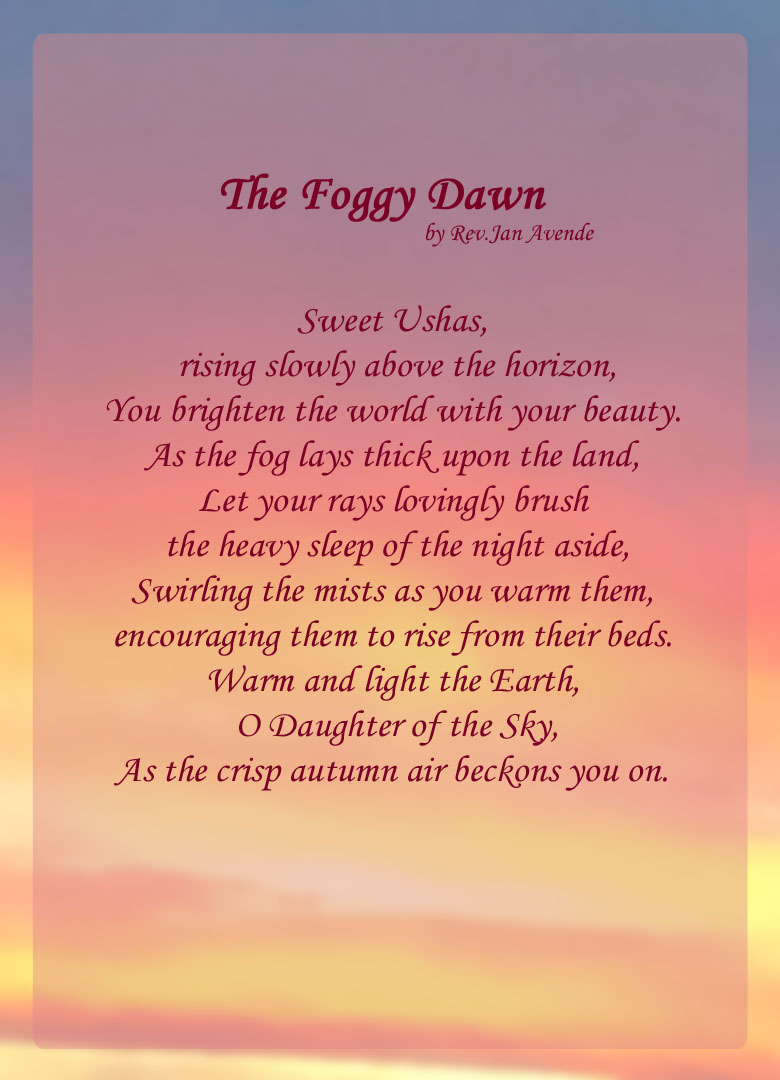
Ushas! O Daughter of the Sky!
You who arise from your bath each morning dripping dew upon the land.
Rosy maid, your brilliant face breaks through the Clouds,
Parting them to shine your light upon the world.
Hopeful Dawn comes: ever rising, ever resplendent,
Still there, breathing life into the world with your radiance.
Burning away the gloom that seems it will never leave.
Imperceptibly you lightens the clouds from grey to pink,
Caressing them to life, until suddenly
The sky is alight and singing new songs of hope.
As you awaken the world to life, and rekindle the Fires upon the Land each morn,
So too do you awaken our pious spirits to sing the praises of the Gods.
Ushas, Accept our Sacrifice!

Ushas, Goddess of the Dawn,
Come to us now on this holy day when the world hangs in balance.
Break through the clouds and aid us in rekindling the Fires upon the Earth
As we seek to Open the Gates, Walk Between the Worlds, and make Sacrifice.
Call Agni, the Priest of the Gods, to us, so that we might pour forth our offerings.

Rekindle the Fire of Hospitality, and let it burn here and within us,
Connecting us to the Spirits of the Land, with whom we walk in balance.
Rekindle the Fire of Protection, and let it burn here and within us,
connecting us to our Heavenly Ancestors, who’s knowledge guides our steps.
Rekindle the Fire of Sacrifice, and let it burn here and within us,
Connecting us to the Shining Gods, who we make offerings to.

Three Fires kindled and burning strong,
Connecting us to the Earth, the Heaven, and the Atmosphere.
These flames burning here and in all the Realms.
Ushas, part the Clouds and Open the Ways,
so that our Sacrifices may be carried forth and our voices heard!
Let the Gates be Open!

Earth (Spirits of Forest)
The Children of the Earth call out to the Spirits of Forest!
You who dwell on the Earth and fill the lands about us.
Allies and guides, whether you be of flesh, stone, or plant.
May the Sun warm you, and the Waters fill you,
The Mountains protect you, and the Earth support you.
We come into this space that is yours,
To be as you are in our honoring of the Kindreds.
We see you, Spirits of Forest, All you Sylvan Things
Stepping through the seven regions of the Earth
out across the many-colored grasses
where the Waters flow down from the mountains and out to the sea.
We see you rising in the east to greatness
with a hundred, thousand branches as we lift our ladles and bring you gifts.
Come to our Fire, Spirits, and meet us at the boundary
Join us at our Sacred Hearth and be warmed by our Good Fire.
Aid us and Guide us as we walk the Elder Ways.
Spirits of Forest, Accept our Sacrifice!

Atmospheric (Deities)
The Children of the Earth call out to the Shining Ones!
You who dwell in the Atmosphere and fill our every breath with divinity.
Brilliant, Mighty, and Awful, we sing your praises.
Bright and splendid, burning and flowing
We see your power and beseech you to come to us,
Gracious and kindly-hearted, and partake of our sacrifice.
We call and call thee, bliss-bestowers,
come to us at dawn and midday, at dusk and midnight.
Be with us as fires strengthen our prayer and our sacrifice:
Wise and Mighty, Loving and Kind, Ancient and Powerful.
You are streaming with abundance, pouring out treasures untold.
Come to our Fire, Shining Ones, and meet us at the boundary
Join us at our Sacred Hearth and be warmed by our Good Fire.
Aid us and Guide us as we walk the Elder Ways.
Shining Ones, Accept our Sacrifice!

Heavens (Ancestors)
The Children of the Earth call out to the Ancestors!
You who dwell in the Heavens and inspire us to reach for the stars.
Sons of mighty Asura, supporting the heavens,
Bound by the life-giving Waters
You search out the path to glory and lead the way.
Come Fathers, and sit on the grass with us
Join us in the warmth of the sun and sweetness of the waters.
We see you as Yama’s hounds roam among us, brindled and dark-eyed,
as they seek those who would ever dwell in the sunlight.
Come to our Fire, Ancestors, and meet us at the boundary
Join us at our Sacred Hearth and be warmed by our Good Fire.
Aid us and Guide us as we walk the Elder Ways.
Ancestors, Accept our Sacrifice!

DotO: Indra 
The Children of the Earth call out to Indra, the Cloud Rider!
On eagles’ wings, borne across the land,
You rush up from the sea upon the very clouds
That bear the waters.
Mighty Indra, Bright as Suns,
Come to us and stand by us in our need.
You are drawn onward by the tawny coursers,
sparks that strike the sky, O Tempest God,
We call to you!
Come down to us from the skies, O Wanderer,
making light where there was none,
making form where there was none.
Golden and Thunder-armed Indra,
You who struck down the Dragon,
and won the Waters for us,
Come, come!
Burst forth from the Clouds and drive us on to glory
as a bull drives on the herds.
Bright Thunderer, full of Soma,
We hear the cows roaring, bellowing, at your victory as you approach.
Come to our Fire, Indra, and meet us at the boundary
Join us at our Sacred Hearth and be warmed by our Good Fire.
Aid us and Guide us as we walk the Elder Ways.
Indra, Accept our Sacrifice!

Prayer of Sacrifice: Agni 
Agni, Bright One, Priest of the Gods,
We have given of our love and our wealth to the Kindreds.
Now, as this sacrifice is poured out, take it, and carry our voices to all the realms:
Through the Forest, where the Spirits may partake of it,
Through the Atmosphere, where the Shining Ones may partake of it,
Through the Heavens, where the Ancestors may partake of it.
Kindreds all, Accept our Sacrifice!

Omen (Fire scrying)
*seer makes an offering to the Fire of Hospitality and seeks the wisdom and blessings there*

*seer makes an offering to the Fire of Protection and seeks the wisdom and blessings there*

*seer makes an offering to the Fire of Sacrifice and seeks the wisdom and blessings there*

Return Flow 
**note: this portion of the rite was performed as a children’s ritual playlet during the rite in March 2015**

Cast:
OFFICIANT: The person who is doing the Return Flow portion of the Ritual
INDRA: The Vedic Storm God
VRTRA: The Dragon
CELEBRANTS: The folk at the ritual
STORM-BRINGERS: sounds of the storm (can be the same as the CELEBRANTS if needed)
Optional Cast:
DRAGONS: Vrtra’s family
SACRED COWS: to represent the Waters and Blessings

*following the Seer’s pronouncement of a positive Omen*

OFFICIANT: These are indeed good omens.

OFFICIANT: But you should know that until Indra won the Waters for us, we could not have received these blessings because Vrtra the Dragon hoarded them all for himself and his family.

OFFICIANT: Here is Vrtra now, and he is holding onto [omen], [omen], and [omen].

VRTRA: These gifts are mine! All mine!

OFFICIANT: But the people wanted the blessings too, and they knew only the mighty Indra could help them now. So they called out with one voice: “Indra, Give us the Waters!”

CELEBRANTS: Indra! Give us the Waters!

OFFICIANT: Listen: Do you hear him coming? Here comes Indra the Storm-Bringer!

*STORM-BRINGERS shake noisemakers as Indra enters the stage*

OFFICIANT: In the thundering clouds with his lightning bolt in hand, Indra demands:

INDRA: Vrtra! You have to share the blessings!

OFFICIANT: Vrtra roars mightily and retorts:

VRTRA: No! These gifts are mine! All mine!

OFFICIANT: And the people knew Vrtra was going to hold onto those gifts of [omen], [omen], and [omen] with all of his might. So they again called out: “Indra! Give us the Waters!”

CELEBRANTS: Indra! Give us the Waters!

OFFICIANT: And Indra heard their plea and prepared to do whatever was necessary to win the waters for the people. He again shouted to Vrtra:

INDRA: Vrtra! You have to share the blessings!

OFFICIANT: But Vrtra again roared his denial and shrieked:

VRTRA: No! These gifts are mine! All mine!

OFFICIANT: Indra grew angry that Vrtra wouldn’t share the blessings with everyone, and as his anger grew, so too did the sound of the storm.

*STORM-BRINGERS shake noisemakers*

OFFICIANT: The people knew now was the moment. Now was the time to give Indra all their support. And so they called out one final time: “Indra! Give us the Waters!”

CELEBRANTS: Indra! Give us the Waters!

OFFICIANT: The storm rumbled as Indra went into battle with the mighty Vrtra, his lightning bolt held high. With a flash he struck down Vrtra with his lightning bolt. The Dragon bellowed as he fell.

OFFICIANT: The waters, the blessings, the gifts were now free. The mighty Indra won them away from Vrtra the Dragon and brought them to us.

*INDRA brings Waters to OFFICIANT*

OFFICIANT: These Waters are infused with the blessings of [omen], [omen], and [omen]. “Behold! The Waters of Life!”

OFFICIANT: As these Waters are poured out for each of us, remember how they were won for us, and how we sing the praises of the Storm God who won them.

OFFICIANT: See how the gifts of [omen], [omen], and [omen] can flow into our lives. See how they can flow into our grove. See how they can flow into our community. See how you and the world can be renewed and rejuvenated by these Waters so courageously won and freely given.

OFFICIANT: Drink deep, Children of Earth, and be blessed!

Thank DotO 
Mighty Indra, Thunderer, Drinker of the Soma Juice,
You who have won the Waters for us.
For joining us today, raining down your blessings upon us,
and lending your Magic to our work as we step forth into our lives,
We say, Indra! We thank you!

Thank Ancestors 
Mighty Ancestors, you who have delighted
in the sunlight with us this day:
For joining us today, sharing your knowledge and joy with us,
and lending your Magic to our work as we step forth into our lives,
We say, Ancestors! We thank you!

Thank Deities
Brilliant Shining Ones, bliss-bestowers,
so full of the riches you’ve freely poured out:
For joining us today, kindling a fire of piety with us,
and lending your Magic to our work as we step forth into our lives,
We say, Shining Ones! We thank you!

Thank Spirits of the Forest
Spirits of Forest, moving softly through the realms of the land,
and rising in greatness like the great trees:
For joining us today, teaching s to walk in balance with the Earth,
and lending your Magic to our work as we step forth into our lives,
We say, Spirits of Forest! We thank you!

Close Gates 
Now, with the Fires still burning and the Center we look to the sky
As we call out once more for our Gatekeeper.
One who stands at the boundaries and walks the liminal places between the Realms.
Ratri! O Child of Heaven!
Your Sister, Bright Ushas aided us in our arrival, as is her due.
Now we ask that you aid us in our depature, O Ratri, as is your due.
Twinkling-eyed Goddess, adorned in all beauty
You bring Order to the World as you guide us from Dusk to Dawn.
So watch over us, Ratri, as we seek to close the Gates.
Shepherd us safely on until we come to this shared space of brightness and worship again.
Ratri, Accept our Sacrifice!

Now, Child of Heaven, Goddess of the Glittering Night,
Come to us and aid us as we Seek to bid farewell to Agni,
Walk Between the Worlds once more, and Close the Gates.
Agni has kindled three brilliant flames before us, bright and strong.
They have been well-fed of our sacrifices, and consumed with delight.
Now let these fires once more become but flame.

Let the Fire of Sacrifice no longer burn here and within us,
but dissipate out into the Atmosphere.
Let the Fire of Protection no longer burn here and within us,
but dissipate out amongst the Heavens.
Let the Fire of Hospitality no longer burn here and within us,
but dissipate out across the Land.

Ratri, as this, our Sacred Center, is no longer lit and shining brightly with Sacrifice,
As we travel between, no Fire at our Center,
Let the Gates be Closed!

Thank Inspiration
Sweet, purifying Soma, bright and potent and overflowing,
Honey-sweet intoxicating elixir:
For joining us today, filling us with the joyous draught of Hero’s wealth,
and lending your Magic to our work as we sang the praises of the Gods,
We say, Soma! We thank you!

Thank Earth Mother 
Rich and Bountiful Prithivi, we are your children, and you are our Mother,
We growth and flourish as you growth and flourish.
For joining us today as you do every day, and supporting us always in our work,
Earth Mother, we return to you all that is unused as we seek to continue to walk in balance.
Prithivi, Earth Mother! We thank you!

Closing the Rite (Three Crane Liturgy)
Go now in Peace and Love and Fellowship, Children of the Earth,
This rite is ended!

Works Cited:
Thomas, Kirk. “The Nature of Sacrifice”. Ár nDraíocht Féin: A Druid Fellowship. ADF. 2011. Web. 4 Apr 2015. <http://www.adf.org/articles/cosmology/nature-of-sacrifice.html&gt;.

Seeking Peace

This sonnet was written as an interpretation of a divinatory reading. I asked “How might [person] find peace in their current situation?” I received Epsilon, Rho, and Tau. The first quatrain interprets Epsilon, the second quatrain interprets Rho, and the third quatrain interprets Tau. The final couplet is the three taken together. I would like to experiment with this style of reading more. I’m drawn to the idea of “prophecy in verse” and enjoy working with Euterpe in this way. It requires a certain amount of time to write the sonnet after taking and interpreting the omen, but I found it worthwhile, and it allowed me to delve deeper into meanings and explore more poetic language as a Seer.

“Seeking Peace”

Come together now and tell of your dreams:
Of desire and the fire within,
Of cool waters, the deep and flowing streams
Shining with blessings as they swirl and spin.

Know sweet Nature’s song is quiet and strong:
A patient voice that nurtures. It carries
on the wind, whispering that you belong.
Walk this path slowly, as the way varies.

Companions by your side, they come and go
as they must, each teaching you a lesson.
Be not afraid, for as they leave, you grow.
A tree: reaching the dawning sun again.

Join with a patience, the long view showing
Peace in acceptance, even when going.