In my clinical pastoral education program for chaplaincy we were asked to examine an ethical framework that resonates with our faith tradition and personal inclinations. I found myself reading through various ethical frameworks, from Consequentialism (ex: Jeremy Bentham) to Deontology (ex: Immanuel Kant) to various Pluralistic Theories (ex: WD Ross, John Kekes). After a thoughtful conversation with our Clinical Ethicist on staff, I found Virtue Ethics, which resonated well, though I don’t align with strict Aristotelian ethics, and have a slightly more pluralistic view.
Continue reading “Examining ADFs Virtues through a Study of Virtue Ethics”pagan
Spiritual Experience, Daydream, or Mental Illness
It is not uncommon for me to field questions and concerns around the theme of “I had this really intense dream/meditation/trance, and I’m worried I might be crazy” or “such and such spirit came to me and told me things, and I’m pretty sure it’s true, but it doesn’t match anything that’s written or anybody else’s experiences” or “Am I just taking myself on wish fulfillment, fantastical adventures in my head and believing it’s true?” As pagans, we work with spirits (including the gods and dead, and those who defy categorization) who are often fairly close to the human world (or share it with us entirely), and in a post-colonial Western society we don’t have a good frame of reference for what is “normal” in spiritwork.
So, how do you find the balance between mental illness, your imagination, and a spiritual experience (or UPG – Unverified Personal Gnosis)? How do you know what is “real” and what is maybe just daydreaming? If you’re already neurodivergent, how do you navigate spiritual experiences while honoring your brain’s very real differences?
Continue reading “Spiritual Experience, Daydream, or Mental Illness”Annual Clergy Report for 2024
This report is designed to illustrate how each individual priest has chosen to fulfill their oath to love the land, honor the deities, serve the folk, and continue in their studies as best suits their individual vocations.
Time covered: January 1 2024 – December 31, 2024
Continue reading “Annual Clergy Report for 2024”Beltane Behind Bars
Yesterday was amazing. I had coordinated to bring three of my Grovemates, Joe, Jeff, and Mike to ORW as volunteers for Beltane. I wanted to make it kind of like a mini-festival day for the inmates. So we had a morning of workshops and then an afternoon ritual.
Continue reading “Beltane Behind Bars”Reflecting on the ‘Total Eclipse of the Heartland’

This past week I had the privilege to travel to Tredara with my family and many other pagan (and pagan-adjacent) folks to experience the totality of the solar eclipse that stretched across the United States on April 8th. “Tredara is a 22-acre facility owned and operated by druids of Stone Creed Grove. It features multiple nemetons, an Ancestor Mound, a shrine to the Nature Spirits, and many other sacred spots” (Stone Creed). Every time I have visited Tredara has been amazing, especially because they always seem to have new shrines each year (this year was a lovely Hekate shrine), but it was especially wonderful this visit because experiencing Totality is absolutely awe-inspiring, and then to see it on sacred ground amongst my spiritual community was ineffable.
Continue reading “Reflecting on the ‘Total Eclipse of the Heartland’”Connections Across Traditions
A lot of my time recently has been consumed with thoughts of theology, relationships, and pan-pagan interfaith work. I’ve been volunteering at a local prison, and attended my first pan-pagan festival in many years recently (Appalachian Summer Solstice at the Wisteria Campground in Ohio). These experiences can be more complex by virtue of the differing traditions, but also very rewarding. By being exposed to the thoughts and teachings of others, and welcoming those differences, I have been able to better examine my own practices and beliefs.
Continue reading “Connections Across Traditions”Teaching Chaplains About Paganism
I had the amazing opportunity to teach a class of Chaplaincy students doing CPE with OhioHealth this week. Their instructor had reached out to me to see if I could help give them some perspective on what types of things pagans belief, and what would help them in times of crisis. The talk went really well, the students were engaged and had good questions. Hopefully I get the opportunity to go back with each new cohort.
Here’s the outline that I sent along to the students:
Continue reading “Teaching Chaplains About Paganism”Harvest & Homesteading
One of the primary ways I’ve found that I connect to the Nature Spirits and to the Earth Mother is through the little suburban homestead that I’ve built. It helps me stay intimately connected to the cycles and seasons of the earth.
Continue reading “Harvest & Homesteading”A Prayer in light of Roe v Wade decision
I know that lots of folks are feeling scared right now with the overturning of Roe v Wade, and the knowledge that more revocation of basic human rights may be on the horizon. And so I offer up these words for those in need. May they bring you comfort. I am here for you.
Continue reading “A Prayer in light of Roe v Wade decision”The Lay of Thrym
Alright, while I am typically known for my work in Hellenic polytheism, when a group under the pagan umbrella spews hate based on race and gender identity, speaking out against that is imperative. I say not here. Not in my house.
The Asatru Folk Assembly posted earlier this week:
“Today we are bombarded with confusion and messages contrary to the values of our ancestors and our folk. The AFA would like to make it clear that we believe gender is not a social construct, it is a beautiful gift from the holy powers and from our ancestors. The AFA celebrates our feminine ladies, our masculine gentlemen and, above all, our beautiful white children. The children of the folk are our shining future and the legacy of all those men and women of our people back to the beginning.”
Again, not in my house. If we don’t stand against this type of of hate and vitriol, then our silence makes us complicit. A line is drawn in the sand, and if we won’t condemn this, take a stand, and clearly state that this is not who we are, any of us under this pagan umbrella, any of us under this human umbrella, then we are complicit. If we don’t pick which side we stand on in these cases, our side will be chosen for us by what we don’t say.
I believe in a “come as you are” religion. My fire is big enough, and bright enough, for all who wish to worship the gods. I will openly denounce those who spread hate, who seek to impinge on the human rights of others, and I will stand beside those who are victims of hate and help to make space for them.
Mythology is ripe with examples of gods and heroes who were themselves, through and through, and didn’t let who they are, or the way they presented, effect their actions or their acceptance of their worshippers. Zeus, Hermes, Herakles, Athena all come to mind.
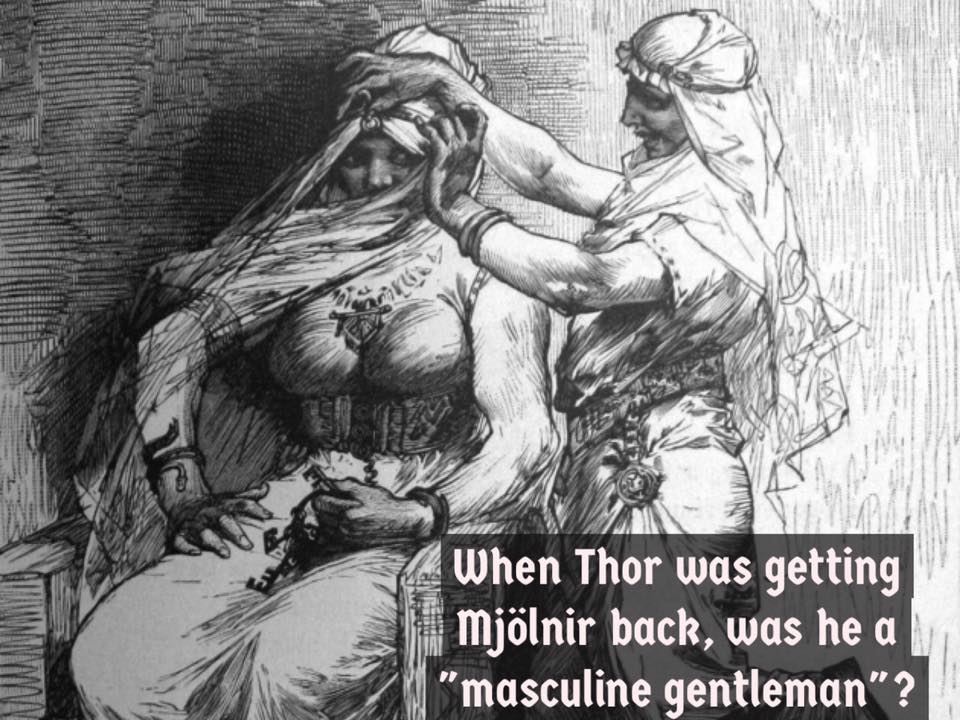
The AFA is a Norse group (I state that affiliation loosely, so as not to offend any of my Heathen compatriots), and so the myth that I find particularly pertinent is The Lay of Thrym. Thor loses Mjölnir to the giant Thrym, who demands to marry Freyja in order for it to be given back. Freya says “Fuck that! Thor, you messed it up, so you go fix it!” Thor and Loki end up dressing as Freyja and her handmaiden to go marry Thrym. How’s that half-giant/half-Aesir cross dressing Thunderer for a”masculine gentleman”?
If you are a Norse pagan, looking for an inclusive home, I’d encourage you to check out The Troth as a Heathen group, and ADF as an Indo-European group. Both have explicit statements of inclusivity as part of their governing documents.
 Mist to Open. Mists to Bind.