The Love of the Sea and the Moon

Once, long ago, the sea was always dark and still as bath water. The moon was calm, with a gentle smile for all who dwelt below her. As the sea grew and swelled he took note of the moon, and thought how beautiful she would be if she would just turn her face completely to the earth.

When the moon was full in her power she glowed with the brilliance of a thousand, thousand stars, all bunched together in joyous dance. The sea was deeply in love with the moon; her brilliance stunned him.  He called out to her with his mightily roaring waves: a declaration of his love. He rushed up the shores, stretching up to meet her. The moon beckoned to the sea, calling him forth, for she also loved him. She adored watching his deep-blue, inky depths brighten to startling ceruleans and teals in her light. She grew even brighter trying to penetrate his depths.

The stars, in the court of the moon, called out to the sea to come join them for their mistress’s sake. The moon dimmed the specks of light around her and snuffed out their sparks in her longing for the sea; she grew ever brighter until finally she had turned to face the earth completely. She ached for the sea to be near her. And so he tried. Every night he lapped at the shores of the land, striving ever towards the sky. Striving to lift himself up to the beautiful moon so that he might join her and her consort of brilliance in their dance.

But then, with each passing day she grew less and less bright. A darkness began to overcome her as she started to lose hope that her lover, the sea, would ever reach her, though he tried desperately every night. Her consort of stars, they grew brighter each night, trying to bring her hope, but still she faded until there was but a small sliver of light left. The sea rushed up futilely against the shore, calling out with his crashing waves for her to come back to him. He pulled himself up ever higher, but still couldn’t reach the sky. Then the moon’s light went out.

The sea sank back down into his watery depths, letting his sorrows be heard in whispering cries as he left the shores of the earth. Desperately he called out one last time, barely daring to hope. The moon, hearing her love in such heartache and pain, turned her face back to him and gave just the ghost of a smile.

This glimmer of her face was enough to give the sea back his hope. With renewed energy he strove towards the shore, this time determined that he could push his waters to leap into the sky. The moon, as she looked down upon him, saw something she’d never seen before: there was her face, with its small, sad smile, resting upon the cresting waves of the sea. She brightened a bit then, and seeing her smile grow in her lover’s arms, poured her heart into her brilliance. She called out to the sea, and he saw now as she did: her love and light was reflected in his depths, and his deep, blue devotion was reflected in the skies all around her.

So now, each night, the sea rushes up the shores to meet the moon and the moon shines down on the sea. They join together in their own brilliant dance of push and pull, ebb and flow, of silver and blue across the sky and rippling waves.


Rekindling the Fire in our New Home

So, Thom and I closed on our house this week.  First time homeowners, yeah!  It’s a been a crazy ride, and we’re so happy and excited.  To prepare of the move, I’ve had to think about how I wanted to handle some of the religious and spiritual things.  I wanted to do something to mark the “claiming of the land” or similar.  Something to say “this is our new home” in the context of my path.  What I eventually decided on, after much deliberation and feeling at a loss for words, was to douse all of my flames the night before, and then light them again at the new house.  My hearth flame would be the first thing across the threshold.

I currently am the tender for the Hellenic Kin’s flame in ADF.  So, I didn’t want to douse that one formally since it belongs to the wider community, so I gave it into the care of MJD (complete with prayer to say), who is keeping it for a few days for me until we’re settled.  The rest of my flames I lit Monday evening.  Called to Hestia as I always do, and made offerings.  I said how I’d be extinguishing the Fires here, and how I looked forward to rekindling them in our new home.  Then I doused them all in the water I had purified earlier in the ritual.

It was really weird to have a night in that liminal space, without the fires of my hearth.  Even weirder was to wake up the next morning and not have a fire as I did my morning devotional.  After we signed all the paperwork and got the keys, Thom and I drove over to our new home.

11008804_10105837793217515_6659179733619836153_n

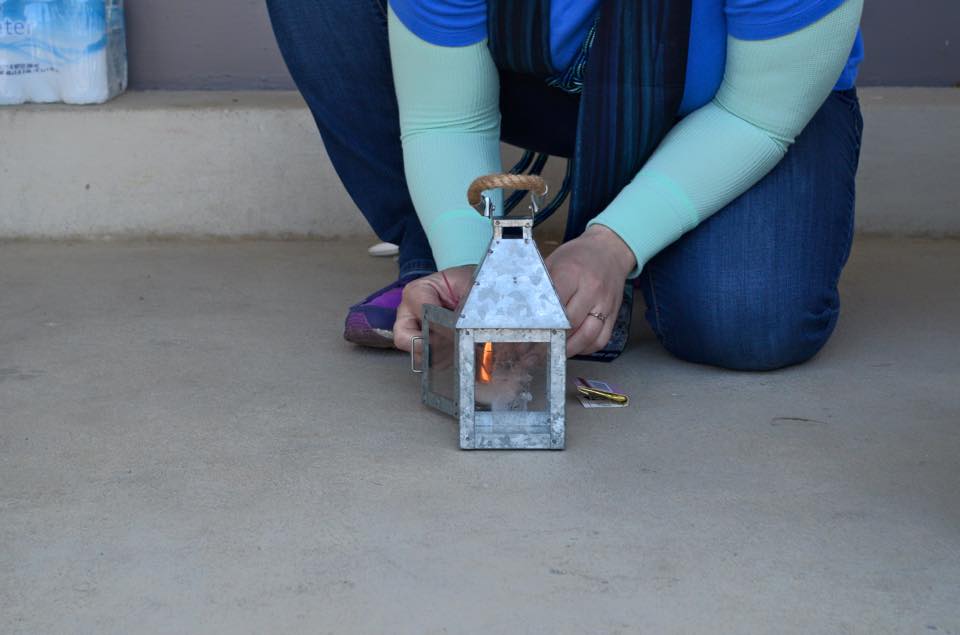
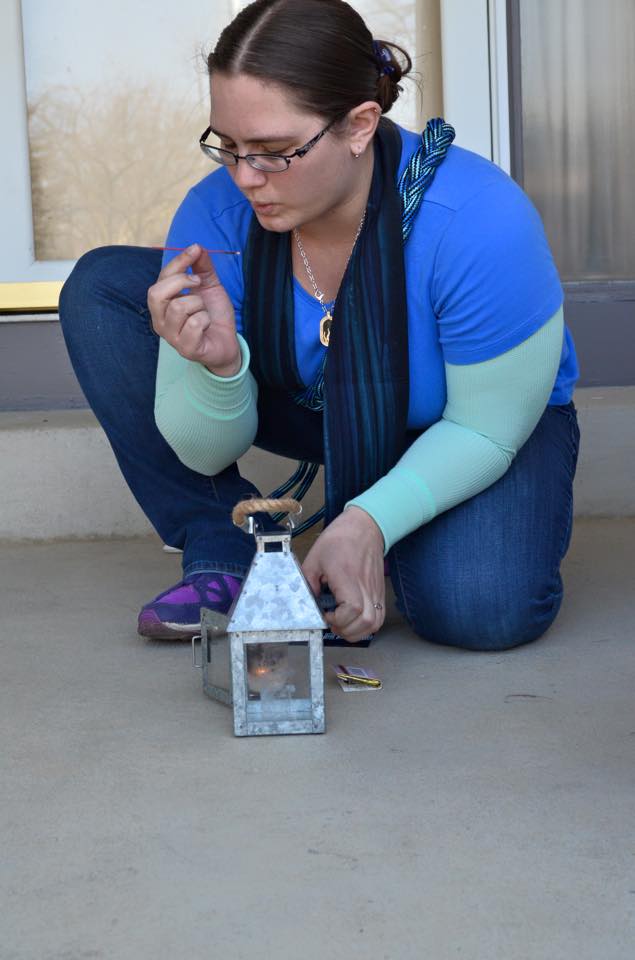
I called out to Hestia and kindled her flame on the front porch.

1508008_10105837793382185_2198126174651897669_n

Then I walked, lantern in hand, across the threshold, and brought the Fire into our home.  It was powerful.  I walked the flame through each room of the house, inviting Hestia to warm and brighten each space for all those who live or visit there.  I called out to the Agathos Daimons, the house spirits, and made offerings to them.  I let them know that we’d be living there with them, and to be welcome around my Fire, and that I’d make good offerings to them.

11080891_10105837794220505_1642025935314791193_n

I then walked the perimeter of the property with the lantern and with barley.  I called out to the spirits of the land and made offerings as I walked.  I invited them to stay and be welcomed by my Fire, but also let them know that if they chose to leave their would be no hard feelings, and they should feel free to disperse.

11081131_10105837794629685_4905956338654597398_n

Then I went into the kitchen, to the place I had already chosen would be the household altar, and set up my simple flame, well, and tree/omphalos.  I thanked Hestia for joining me in this new home and thanked the spirits of the house and the land for listening to my words.  I let them know more offerings and prayers would be forthcoming through then coming days and months, and that I looked forward to building a relationship with them.

It was a very powerful experience.  Moving from the light of my home, to the darkness of between, and then back into the light at our new home.  We’d done a couple walk throughs during the process of buying, and so we were familiar with the layout and everything.  But it was amazing, the way the addition of my hearth goddess and her flame, and introducing myself to the spirits there really made that big empty house feel like home.

Trance-Along: Finding a Shared Space

We’ve decided to begin trying to build a shared space for the Trance SIG in ADF.  We are to looking for keys, or images, or signs that will help us to identify and create a shared space for our trance work.  Our first trance-along journey was done during this past new moon (and the day on either side of it).  The idea is to do trance-work as a group like this once a month during this time.

Here’s my write-up from this inaugural trance along with the Trance SIG.  In general it was very restless feeling, and an unusual landscape for me (I usually don’t go underground, or to places that are particularly dry.  This was both.  So, here we go:

In a desert landscape full of sandy soil and thigh-high and sharp grasses.  It felt very alien and unfamiliar.  I feel like I spent a lot of time wandering aimlessly through the grasses, without wanting to touch them.  Sometimes traveling by walking, and sometimes traveling by burrowing through the sandy soil.  It was surprisingly easy to dig through and allowed the forming of intricate tunnels and burrows. The burrows and tunnels seemed to stretch on infinitely, like I could spend a very long time exploring them, and digging more to get to where I need to go.  There were scratched symbols at some of the places where tunnels split, but I couldn’t make out any exact symbols.  I felt extremely comfortable in the tunnels.

Oddly, whenever I went underground I could just barely catch hints of what sounded like 8-bit video game music.  (Weird).  When I came up from the burrows I could see the sky.  Dark dark black, with way fewer starts that I expected to see in comparison to how dark the sky was.  They were very bright white pinpricks.  Some were very static in there place, and some were little splashes of swirling pinpricks.  The sky is very heavy.  Feels almost crushing.  Like I don’t want to be out in the open for too long.

Later in the trance there were little cyclones touching down in the grass and sand.  Small, little whirlwinds that were making shallow holes where the touched down, and spitting up bits of grit and sand.  They didn’t seem to be traveling at all, but rather touching down, remaining in place for a while, and then dissipating.

Most of the landscape felt very abandoned.  At three separate instances there were horses, or maybe some form of very large deer?  They clearly used to be domesticated, but weren’t so much anymore and were trying to return to being wild, but weren’t quite there yet.  The horses just ran across the landscape, close to me, maybe 2 or 3 arms lengths away. Just into my field of visions and out again.  Alone each time.  It was like they were trying to rung rom something, but not with fear, and were also trying to get somewhere, and with a very distinct and purposeful gait.

There was also something prowling and rustling in the grasses, circling around me.  I suspect this was my Lynx friend, but she didn’t show herself, which is unusual for her when I’m doing journey work, especially to new places.  So that was weird.

Anyways, that’s what I got.  I could see either exploring the tunnel further or perhaps following the paths the horses took, since they seem to be cutting throughout he grasses and making the way less treacherous.

For reference, I use polyrhythmic auditory confusion as my go-to method for entering trance.

Introduction to a New Deity

An important part of our relationship with the deities revolves around *ghosti and hospitality.  Part of hospitality is a politeness when you are first meeting someone.  A good way to meet new people is through mutual friends, and having one introduce you to the other.  This is similar to the way a relationship with a deity can develop. A devotee, or someone else who has familiarity with a deity can act as a liaison or intermediary to help forge a new bond.
This is structured to allow the devotee to call out to the deity and honor them with words and offerings, and then to introduce them to the new person who wishes to work with them.  They use their personal authority to encourage the deity that as they make offerings, there are others who also wish to do so.  The new person then speaks, and makes their first offering to the deity, asking them to come to them and begin to grow that bond so that they may continue to worship the deity.
Devotee:
[Deity], hear me!
[insert appropriate invocation and words of praise]

[Deity], I come here on behalf of [person].

They wish to develop a relationship with you,
And come bearing gifts.
As I have worked with you, honored you, and praised you,
I ask now that you turn your attention to [person].
They wish to work with you, honor you, and praise you.
[person]
[Deity], I am [name],
and I come with gifts for you.
*make offering*
Come to me so that we get to know each other
and so that I may work with you, honor you, and praise you.

Making Sacred Ink

For the Full Moon honoring Hepheastos, the Smith God and Crafter, we will be making ink from the ashes left from our burnt offerings and the Waters gained the Return Flow.  This ink can then be used focusing the intent for other magical work, from sigil work to staining divination tools to spelled tablets or prints.
Items Needed:
1 part ash from burnt offerings
1 part water from Return Flow
1 drop white vinegar (optional for ink stability)
bowl that can be stained (for mixing)
hard-bristled brush (for mixing)
To being mixing the ink put the ash in the bowl, add the water.  Each person participating in the working will stir and mix the ink with the brush while saying the charm below (the charm can then also be said when reconstituting the mixture or making more).  When it looks like ink, mix in a drop of vinegar, and you’re done.
CHARM:
Great and Mighty Hephaestos, Master of the Tempering Flame
Sooty God, who is famed in many crafts,
Renowned metal-smith and skillful worker,
Inventive and Resourceful One,
Your fame and glory resound with each strike of your hammer on anvil.
I have made offerings, consumed by the Fire.
My gifts have risen on smokey pillar to the Heavens above.
All that remains here is charcoal and ash.
Take what is left, Skillful Creator,
Take the leavings, the forgotten, the dross
And guide my hands in finding use for this too.
Now mix your magic with mine
as I seek to create tools from the discarded.
Ash from the Sacred Fire,
   *put ash in the bowl*
Water from the Holy Well,
   *put water in the bowl*
Bound now together as I chant these words:
   *begin stirring and mixing as you chant.  repeat as necessary until it is well mixed*
Aithaloeis Theos! Sooty Hephaestos!
Grant me your skill as I mix this ash!
Polymetis! Resourceful Hepheastos!
Grant me your skill as I mix this ash!
Klytoteknes! Famed in Crafting Hepheastos!
Grant me your skill as I mix this ash!
Polyphron! Ingenius and Inventive Hephaestos!
Grant me your skill as I mix this ash!
   *once ink is made, add drop of vinegar if desired to stabilize the mixture*
With this ink thus created
Let me not forget the power of sacrifices made.
Let me not forget the power of Hepheastos, the Crafter,
In his ability to create powerful tools
From even those things considered useless or waste.
With this ink, I may now focus my intent for future tasks.

Indra Wins the Waters

“Indra Wins the Waters”

 
This playlet was written for the children’s programming for
Three Cranes Grove 2015 Spring Equinox Ritual honoring Indra.
 
Lexile: 680L (late 3rd grade, early 4th grade reading level) 
 
Cast:
OFFICIANT: The person who is doing the Return Flow portion of the Ritual
INDRA: The Vedic Storm God
VRTRA: The Dragon
CELEBRANTS: The folk at the ritual
STORM-BRINGERS: sounds of the storm (can be the same as the CELEBRANTS if needed)
Optional Cast:
DRAGONS: Vrtra’s family
SACRED COWS: to represent the Waters and Blessings
 
*following the Seer’s pronouncement of a positive Omen*
 
OFFICIANT: These are indeed good omens.
 
OFFICIANT: But you should know that until Indra won the Waters for us, we could not have received these blessings because Vrtra the Dragon hoarded them all for himself and his family.
 
OFFICIANT: Here is Vrtra now, and he is holding onto [omen], [omen], and [omen]. 
 
VRTRA: These gifts are mine! All mine!
 
OFFICIANT: But the people wanted the blessings too, and they knew only the mighty Indra could help them now.  So they called out with one voice: “Indra, Give us the Waters!”
 
CELEBRANTS: Indra! Give us the Waters!
 
OFFICIANT: Listen: Do you hear him coming?  Here comes Indra the Storm-Bringer!
 
*STORM-BRINGERS shake noisemakers as Indra enters the stage*
 
OFFICIANT: In the thundering clouds with his lightning bolt in hand, Indra demands:
 
INDRA: Vrtra! You have to share the blessings!
 
OFFICIANT: Vrtra roars mightily and retorts:
 
VRTRA: No! These gifts are mine! All mine!
 
OFFICIANT: And the people knew Vrtra was going to hold onto those gifts of [omen], [omen], and [omen] with all of his might.  So they again called out: “Indra! Give us the Waters!”
 
CELEBRANTS: Indra! Give us the Waters!
 
OFFICIANT: And Indra heard their plea and prepared to do whatever was necessary to win the waters for the people.  He again shouted to Vrtra:
 
INDRA: Vrtra! You have to share the blessings!
 
OFFICIANT: But Vrtra again roared his denial and shrieked:
 
VRTRA: No! These gifts are mine! All mine!
 
OFFICIANT: Indra grew angry that Vrtra wouldn’t share the blessings with everyone, and as his anger grew, so too did the sound of the storm.
 
*STORM-BRINGERS shake noisemakers*
 
OFFICIANT: The people knew now was the moment.  Now was the time to give Indra all their support.  And so they called out one final time: “Indra! Give us the Waters!”
 
CELEBRANTS: Indra! Give us the Waters!
 
OFFICIANT: The storm rumbled as Indra went into battle with the mighty Vrtra, his lightning bolt held high.  With a flash he struck down Vrtra with his lightning bolt.  The Dragon bellowed as he fell.
 
OFFICIANT: The waters, the blessings, the gifts were now free.  The mighty Indra won them away from Vrtra the Dragon and brought them to us.  
 
*INDRA brings Waters to OFFICIANT*
 
OFFICIANT: These Waters are infused with the blessings of [omen], [omen], and [omen].  “Behold! The Waters of Life!”
 
OFFICIANT: As these Waters are poured out for each of us, remember how they were won for us, and how we sing the praises of the Storm God who won them. 
 
OFFICIANT: See how the gifts of [omen], [omen], and [omen] can flow into our lives.  See how they can flow into our grove.  See how they can flow into our community.  See how you and the world can be renewed and rejuvenated by these Waters so courageously won and freely given.
 
OFFICIANT: Drink deep, Children of Earth, and be blessed!

My Vocational Statement

When did you hear the call to the path of ADF Priesthood? What did it sound like?

When I was first considering what direction to go following the approval of my Dedicant Path documentation I waffled for a long while between the Initiate Path and the Clergy Path.  I talked to current initiates and priests.  I asked questions.  I did divination, journaled, and wrote a lot.  When I asked the counsel of my gods, it was obvious to me: I needed to do the Initiate work.  I didn’t feel ready, and didn’t know that I would ever feel ready, to embark on the path of clergy.  I still felt like I had a call for it then, but it was quiet and I questioned whether it was actually there.  I wanted to do the Initiate work first.  I needed to solidify my own practice before I could truly listen to see if the call was true.


The closer I got to completing the course requirements for the Initiate Path, the more I noticed that as I was growing in my own work, the louder the call was getting, and the more insistent.  As my own practice grew, I began seeing places where I could offer my knowledge and skills to those around me.  I feel that, next to walking your walk and owning your path, it is imperative to help others walk their path as well.  I found myself seeing voids in the community, and they were voids that I could fill.  I began leading Full Moon rituals every month, with the focus for those rituals being the magical work that we didn’t really get to do or engage in elsewhere.  It was also a place where I have fostered a “no fail” zone.  I wanted to help others find their voice, the way I felt like I was finding mine.


As I reached the final months of journaling for the Initiate Path, my call to the work of the priest solidified.  It felt just as obvious to me as my initial decision to embark on the Initiate Path first.  I knew without a doubt that I needed to first complete that work, and that I could then allow my focus to shift and set my foot upon the path of clergy work.  The paths all merge.  The work of the Dedicant is the first stream.  As it flows along, other rivers join it, bringing with their new waters new inspiration, new knowledge, and wider banks.  The Dedicant stream continues to flow strong in the river of my own Druidry, and will always flow in my river as its headwaters.  It has been joined by the Initiate Current, which brings a deeper understanding and a deeper level of work.  These two rivers flow, their waters mingling, and yet each flowing just as strong, now a single river.  As I encounter new waters, like the work of the Clergy, the river will continue to flow, and grow stronger as all the waters mingle.  My work as a Dedicant is a constant, ever continuing path, as is my work as an Initiate now, feeding the river.  I see the work of a priest the same way: once joined they are ever flowing, becoming just as much an integral part of the river as the other waters.


I want to be a priest because I want to help others on their path, whatever that path may look like to them.  I want to provide liturgy to folks who are having trouble coming up with something fitting on their own.  I want to provide my knowledge and skills to those who need them.  I want to help grow our children in our tradition.  I have built my strong foundation, and the pull has intensified.  I understand why so many people refer to it as a “Call.”


It is not a loud resounding gong, nor a can I necessarily put my finger on an exact moment that I felt called, but it is a constant and insistent part of my being now.  It is a constant ringing in my ears and a constant throbbing in my being. The clergy serve the gods the folk and the land, and that is what I feel drawn towards, pulled towards, called towards.  I’ve grown in my understanding of this faith community, and I’ve come to realize that what I want to do and who I want to be can’t be done elsewhere.  The sound of the call was when I heard the sound of that need in my community, when people started looking to me in that role, and when I was able to begin seeing myself in that more confident and capable place.  When I understood that by becoming an ordained priest I would be able to answer that call and fulfill that need, it felt right. The call encompasses the sounds of multiple melodic lines weaving together in harmony as the gods, the folk, and the land all sing together in my soul.


What form do you expect your vocation to take?

I have been doing a lot of work as an Initiate that has revolves around part of the oath that states “…and with these tools I will lead others to the flame.”  My vocation I expect will continue to reflect this work.  I will be involved in making Our Druidry accessible to any who seek it.  For any who seek the flame, I will act as a guide on their path, aiding where I can, challenging when I need to, and supporting always.  I will be involved in the educational programs that we have (in the form of the DP, IP, CTP, and Guild SPs), and with those that are just now blossoming (such as children’s programming, especially locally). I want to help grow ADF into a church that my children can be a part of and feel connected to from a young age.  I want to help develop programming that engages our new members, particularly those who are being raised in our traditions.  One of the biggest draws to ADF for me is its inclusiveness and family-friendly nature, and I want to help grow that.


There is great joy and potential in the balance that exists within ADF between faith and scholarship, between practice and study.  I want to help others see that same joy.  I want to help others in ADF blossom in their practice, and should they decide to embark on the course of higher study within ADF, I want to make sure that the coursework is accessible to them in a way that they can demonstrate their knowledge and understanding. I want to help others feel capable and confident in adapting their hearth culture and practice into the greater whole that is ADF practice. I want to help others find their voice.


Do you feel prepared to become an ADF Priest now? Do you see further work that you will need to do to prepare yourself for the work ahead?

I feel as ready as I can without having actually set foot on the path yet.  I know that I am going to run into obstacles and challenges, but I feel confident that while I won’t be prepared in the sense that the challenge wouldn’t have happened, that I am prepared in that I will be able to work with or around the issues that arise.


There is always work to do, and there is always room for more growth.  I don’t think I will ever be done learning and improving.  There are always new things to learn, and new things to experiment with.  There are specific experiences that I lack, but that I’m not sure can be gained before ordination.  I’ve never married anyone, though I witnessed folks declare themselves for each other.  I’ve never helped anyone cross the veil, though I’ve sat with those left on this side.  I’ve never done conflict resolution from a religious point of view, though I it do it on a regular basis at my job and amongst my friends.


These are life experiences, and I think they simply take time.  I cannot say with certainly how I will handle them when the time comes, but I feel that I have been well prepared, and have a solid support network of my own in the form of current Priests and the Kindreds to draw on when I need help or guidance along the way.


Clergy is not all weddings and funerals.  It’s not that glamorous or that that clear cut.  It’s listening and liturgy.  It’s meditation and magic.  It’s the interactions and relationships you develop.  It’s about the day-to-day work – the hundreds of small differences that you are able to make in the lives of those around you.  It’s about fostering a community and growing and tending what you have.  It’s about the thousands of minute details and small-scale actions you take each and every day to serve the gods, the folk, and the land. That I am prepared for.


We are all students, and all continually growing beings. There is nothing wrong with, and perhaps even something good about, accepting that the path we walk doesn’t have a clear end and that there is something new around every twist and turn.  I am prepared in this sense, because I have faith that I can handle the experiences that are to come with the skills that I have gained along the way.
Discipline 1

Discipline 1


  1. Describe your discipline practice as an ADF Clergy Student. Explain what you have learned from this practice, describe how your connections with the Earth Mother and the Gate Keeper have grown and changed over the time you have worked with them, and reflect on your journals and omens over the period. (min. 600 words)


What I’ve learned from this practice:

There are many things that I learned from keeping a regular devotional practice.  A large part of this preliminary building of this practice happened when I was working through the initiate program, and holding to that same level of practice has continued to serve me well as I embarked at the clergy training program.


One of the things I learned from building this practice is that I enjoy speaking my prayers out loud.  It sounds simple and perhaps like a no-brainer, but when you’re at your shrine or altar and by yourself, there doesn’t seem to be a need to say anything out loud.  You could theoretically just say it in your head.  But I’ve found that not only do I really enjoy speaking aloud even in my solo rituals, I also get more out of my work and my practice when I engage with my practice verbally.  It brings it more to life for me.


Another one of the things I reaffirmed when continuing this practice is that there is true value in regular practice.  I noticed this when I was preparing for initiation and drastically increased the number of full core order rituals I did each week to nearly one a day.  I have backed off a bit from that since then, but it has been more because school started up again and I’m limited in the amount of time I can sacrifice during the school year.  I still do at least one full ritual a week, and try for two to three. I’ve found that the more I pray, the better I feel, and the better I feel the more I desire to pray.  It is a cycle that builds on itself, building my practice and helping me grow in the process.


Something new in this practice has been the addition of retreat days.  I’ve enjoyed adding the monthly retreat day to my practice, though I’ve found it more difficult than I was expecting.  Initially I tried to take the whole day and devote it entirely to my spiritual practice. That didn’t go well.  With a child under the age of two, I just couldn’t take that continuous chunk of time away.  I should have remembered going through that same process when my daughter was even younger as I was starting on the Initiate Path.  I relearned, or maybe reaffirmed, that in order for my spiritual practice to work it has to be part of my life, not apart from it.  While it is important to set time aside for just me in my spiritual studies and devotional practice, it is also important to kindle that flame in all parts of my life and let it brighten everything from there.  The following months, as I learned to incorporate the work of the retreat days into my life, began flowing smoother and becoming another part of my spiritual practice.


How my connections with the Earth Mother and Gate Keeper have grown and changed:

As I started the clergy training program, and began incorporating the Earth Mother and the Gatekeeper into my rites in a different way, a more prominent way, than I had before, I began to see changes in how I viewed them.  Shortly before completing the IP I made the decision that I would pursue the clergy path following my initiation.  So, when I started on the CTP, I began working with the Earth Mother and Gatekeeper I had just met.  They are distinct and different from whom I typically call in ritual to work with in the roles of Earth Mother and Gatekeeper (Gaea and Hekate, respectively).


This Earth Mother I met seems to exude an overwhelming sense of soft, warm, and motherly love.  She is less fierce than Gaea, and is who I have started working with in clergy work.  She is her own distinct being, and somehow seems even more all-encompassing, and all-mothery than an individual hearth-centric deity does. I also met, during the course of this work, a much darker and more primordial Earth Mother.  She was awful and haunting and fierce.  She is, I believe, a different being that the Earth Mother I’ve been working on building a closer relationship with. She is much more mysterious than the Earth Mother, and seems to be just a small step past Chaos.   She holds the seeds of potential and shepherds them as a fierce and protective Mother to their fertile soil and into the care of the things or people that will help them grow.


The Gatekeeper I’ve been working with throughout the course of this is also the one I met during initiation.  He seemed partially made of mist.  He may have been the inspiration for Manannan, or Manannan for him, but they were clearly not the same being.  He is the Lord of Wisdom and Opener of Ways.  He is a sharp contrast in a lot of ways from my usual way of working with the Gatekeeper, probably in large part because I work with a female Gatekeeper most often in ritual.  When I work with Hekate as a Gatekeeper, there is still that mixing and mingling of magic to do the work. When she walks between the realms, she literally moves between them, and exists fully in each one that she enters, and not existing in multiple realms at once. In working with her, she will guide you from place to place, from realm to realm. However, with the Gatekeeper, he is much more liminal. He can exist in multiple realms at once, and when you work with him, you also are able to drift like the mists and exist in the place between those realms as well as having a feel of existing in multiple realms at once.


My reflection on journals and omens from the period of this work:

During each full ritual I did throughout this work I drew an omen, of either 1 or 3 symbols, which was every few days.  One of the things I’ve done to analyze my omens from this period is compile all of the symbols I drew into a frequency graph. A large percentage of those omens contain Eta, Beta, Iota, and Mu (see graph).  Eta is the oath symbol, and while I was working on Divination 2 I found that when I did readings for current priests I almost always pulled Eta in their readings.  Eta literally means: “Helios who watches all, watches you.”  Beta is the helping gods that support you on your path.  Iota and Mu are both work.  Iota is the external work that is done and allows you to pursue excellence.  Mu is the internal work that is done and allows you to make admirable changes within yourself.  I did not drawn Omicron at all throughout the course of taking omens during this time period, which I find both interesting and applicable.  Omicron is literally “There are no crops that are not sown.”  Because I have been doing the work (Iota and Mu), have been supported by the helping gods of my path (Beta), and am keeping my current oaths as I prepare to take another (Eta) I have no need to worry about not having laid the proper groundwork to proceed on my path.

CTP Omens

Ethics 1

(note: I occasionally reflect on my ethics in a formal way.  You can find those reflections here, and my most up to date Personal Code of Ethics here.)

1) Find and provide an appropriate definition, discuss your understanding, and provide illustrative examples for each of the following seven terms: morals, values, personal bias, professional boundaries, confidentiality, right and wrong (100 words each minimum, not including definitions)


Morals: 

“those values that give voice to the needs and legitimate expectation of ourselves and others” (Weston 3)

moral (Merriam-Webster)

: concerning or relating to what is right and wrong in human behavior

: based on what you think is right and good

: considered right and good by most people : agreeing with a standard of right behavior

Morals are those things within ourselves that help guide us on an ethical path.  There is a reason the term “moral compass” is a fairly common phrase.  Morals can be a tricky issue because what is in line with an individual’s personal morals, may not be in line with the morals of society.  In those cases the line blurs between which route should be taken when making decisions (ie: a “moral dilemma”).  This is partially where the idea of the moral compass comes from: this idea that we have a set of internal values and morals that guide us when we feel there are injustices being done in the wider scheme of things.  Morals guide us in how to act when we consider what it is that we value.  Morals are often tied tightly to hot-button issues (like gay rights and abortion) since they can differ from person to person with each having strong arguments to why they are right, which in turn leads to discussions of moral dilemmas.


Values:

“those things we care about; those things that matter to us; those goals or ideals we aspire to and measure ourselves or others or our society by.” (Weston 3)

value (Merriam-Webster)

: relative worth, utility, or importance

Values are often big-picture ideas.  They are the things that we aspire to make better in ourselves and in the world, because they are things that we are passionate about and believe will help make the world a better place, or help us to make our microcosm a better place.  These can be things like equality, happiness, and education.  For example, I value education, and think that everyone should have the equal opportunity to learn with the least amount of obstacles in their path.  This means for me in pursuance of my values I will do what I can to make knowledge, learning, and training as accessible as possible for those around me who desire to better themselves in this way.


Personal Bias:

bias (Merriam-Webster)

: a tendency to believe that some people, ideas, etc., are better than others that usually results in treating some people unfairly

Personal biases are beliefs that predispose us to think or feel a certain way.  What it means is that with a personal bias we go into a situation already holding some beliefs about it.  This clouds our ability to be objective and impairs us when we seek to approach all on equal footing.  It may impair our ability to treat others in a fair and just manner.  It is often drawn from a place of privilege, and thus becomes extremely important for us to be aware of our personal biases so that we can compensate for them in our interactions.  This can be seen especially in instances of working with individuals who in some way aren’t like us.  An example that is seen all too commonly in our society and in the media is that blacks in America are often viewed suspiciously, and that view is nearly always based on nothing more than the color of their skin and the personal bias that whites and white society has against them.


Professional Boundaries:

boundary (Merriam-Webster)

boundaries : unofficial rules about what should not be done : limits that define acceptable behavior

Professional boundaries are lines that we should not cross when we are acting in a professional capacity.  This often refers to things that are acceptable when we are not in our professional role, but that are considered out of line when we are. This can be things like drinking in public, close friendships, and romantic/sexual relationships.  If professional boundaries are set early in a professional relationship they are less likely to be broken since all parties will know where they stand.  For example, with my students, professional boundaries are clearly established from the outset.  They understand the dynamic, and even when working with my high school students, where those boundaries can relax a bit, there is still a line in our conversations and interactions that cannot be crossed.


Confidentiality:

confidential (Merriam-Webster)

: showing that you are saying something that is secret or private

: trusted with secret or private information

: marked by intimacy or willingness to confide

: entrusted with confidences

Confidentiality is when information is told by one person to another and the second person agrees to keep that information private.  In some cases confidentiality is explicitly understood.  This is often because it is either marked that way (often seen in the case of government secure documents) or the person sharing the information initiates the conversation with a phrase something along the lines of “can I tell you something in private?”  Confidentiality can also be implicitly understood.  This happens often in one of two ways.  Either the two parties are involved in some sort of relationship (romantically, platonically, professionally, or otherwise) where there is an expectation that information shared in conversation won’t be shared, or the information that is shared is expected to be recognized as confidential information due to it’s nature (often emotional or related to others relationships). In some states confidentiality between clergy and their congregation is also protected by law.


Right:

right (Merriam-Webster)

: morally or socially correct or acceptable

: righteous, upright

: being in accordance with what is just, good, or proper

Right is more subjective than other moral indicators. When something is right, it is often judged by a single person and determined based on whether or not it is in line with their worldview.  Right is often a qualifier to other words, such as socially right, morally right, financially right, etc.  Things that are right worldview are influenced by our ethnicity, our religion, our socioeconomic class, our education, among others things.  The different mix of these variables will lead to each person have a variable sense of what is right.  An example something that is viewed as ‘right’ is the belief that we should be sure that every person can receive the care they need to be healthy.  People may differ on how we go about that, but in general many, if not most, can probably agree that it is right for everyone to not suffer due to lack of care.

Wrong:

wrong (Merriam-Webster)

: behavior that is not morally good or correct

: an injurious, unfair, or unjust act : action or conduct inflicting harm without due provocation or just cause

: something wrong, immoral, or unethical; especially : principles, practices, or conduct contrary to justice, goodness, equity, or law

Like the indicator of right, wrong is also more subjective than other moral indicators. Something is wrong when it goes against an individual’s worldview.  This once again is often a qualifier for other words (social, moral, financial, etc.).  Things that are wrong in our worldview are again influenced by our background (ethnicity, religion, socioeconomic class, education, etc.).  The different mix of these variables will lead to each person have a variable sense of what is wrong.  An example of something that is viewed as wrong is murder.  Even if there are sometimes morally gray areas about whether or not someone should have been killed, murder is generally agreed upon as wrong, even if there is justification for it.


2) Self-awareness is key to the implementation of professional ethics. Discuss how your personal morals, values, bias and ability to maintain adequate boundaries, confidentiality and determine right from wrong might both positively and negatively impact your professional relationships. (200 words minimum)


My own personal morals and values have been helping me determine right from wrong for quite sometime now.  They are growing and shifting as I gain more life experience, and I hope that I will continue to be able to fine-tune them as I continue to grow.  I currently work in a field (education) where I have to work with a large variety of people, many of whom come from very different backgrounds than me.  I fell that this has made me more adaptable when it comes to understanding my personal bias on issues as well as negotiating the line of professional boundaries.  I’ve had to engage with my biases and work to understand how they are influencing me and how to overcome and account for them.  I’ve taken the time to unpack my invisible backpack and examine the privileges that I have in my life (McIntosh).  The fact that I’ve already done a lot of this work, and continue to do it in my profession everyday positively impacts my ability to carry over this knowledge into the professional relationships that I will develop as a priest.

The point that I think I will have the hardest time doing, and so will have to continue to be self-aware of, is working on maintaining professional boundaries.  In teaching, this hasn’t been a problem because from the very outset, the line is already there with my students and my coworkers.  This will be the same for people that I meet in the new role as priest.  I think the fuzzy line that I will have to carefully walk is with those people who I already have some sort of relationship with.  The folks that I am already friends with in my local community when they begin interacting with me in the way they would with a priest, I will have to walk that line.  I don’t foresee a problem regarding any romantic relationships forming within my local community, so while it is something to be aware of, it shouldn’t be a problem.  I will have to be careful that any favoritism I show, perceived or actual, is kept to a minimum because it will likely reflect on this new role.  This would negatively impact the professional relationships that I will develop as a priest.


3) Discuss how an individual learns to determine right from wrong and explain the factors that influence this determination? (100 words minimum)


As individuals we are conditioned from a young age.  We learn as children, both directly and through observing others, the way to act and how to speak.  Through positive and negative reinforcement and positive and negative punishment we learn what things lead to good results and what things lead to bad results.  As we continue to develop as adolescents and young adults we begin to learn more about determining right from wrong as we become more in tune with social pressure.  We learn that there are gray areas, and ways that we believe differently from those around us, or from the world as a whole.  This is evidenced by the multitude of posters that hang up around school buildings that say “What is right is not always popular.  What is popular is not always right.”  Throughout our lives we learn to determine right from wrong based on the values we place on others things in our lives.  For example, those who are religiously devout (or were raised in a religiously devout environment) often drawn on the knowledge gained in their religious studies to help inform their sense of right and wrong.

4) Describe several reasons why an individual would strive to “do the right thing”? (100 words minimum)


A huge driving factor in the motivation to do anything is “because it feels good.”  Part of our conditioning when learning to do the right thing builds on making us feel good when we do so.  It isn’t always a straight line, and there are several other factors that may go into striving to do the right thing because it feels good, but that is a huge part of it.  Sometimes a person will strive to do the right thing because it directly benefits them, and that makes them feel good.  Sometimes a person will strive to do the right thing because it will benefit their community, and doing good makes them feel good.  Sometimes a person will strive to do the right thing because they want to conform to the social pressure to do the right thing, and the level of stress that exists when we are fighting social norms and peer pressure isn’t there, so that feels good.  Sometimes people will strive to do the right thing because of a belief in karma, or “if I do good now, surely the universe will pay me back in kind later” and that reassures them, giving them hope, and thus making them feel good.


5) Discuss how an individual’s values relate to the decision-making process. (100 words minimum)

Because values are “those things we care about; those things that matter to us; those goals or ideals we aspire to and measure ourselves or others or our society by,” it is those values that allow us to classify each action as right or wrong, moral or immoral (Weston 3).  Our values guide our conscience, our moral compass.  When we are considering what action to take, or if we should take an action, we consult our moral compass, and what things we see as valuable.  If we value honesty, then we would be less likely to lie to someone because that would go against our view of what is moral.  By having a set of values that we can identify, we are able to consult those values when determining how our actions reflect or agree with them.

6) Discuss the importance of ethics to the clergy-lay relationship. Do you believe a clergy person has ethical responsibilities? If so, what are these responsibilities? (300 words minimum)


I think all people have ethical responsibilities, and this is especially true for people who have a professional relationship with others where there is a perceived or actual power imbalance.  Because priests within ADF are granted the mantle of priesthood by the Folk, it is essential that we interact with them in an ethical manner.  It is imperative that we approach the Folk with respect and fairness.  While being an ADF Priest does not necessarily make one a role model or a leader by virtue of holding that title, there are many who still place weight on the actions and words of those who wear the stole.  Whether or not it is asked for, having the title of Priest means that there is often an implicit trust that comes with it when dealing with the Folk.

The Folk trust us to speak with them in confidence when they come to us with a personal issue.  They trust us to not use that information against them, or to gossip about them.  The Folk trust us to act with fairness.  We must be careful not to show favoritism, and to be aware of what acts may be perceived as favoritism so that we can find other approaches. The Folk trust us not to use our title for personal gain, whether in the organization’s politics or in interpersonal relationships.  We should strive to get places based on our own merit, and not through use of our title.  This means that we shouldn’t attempt to “pull rank” for something that would benefit only us.  Additionally, we should be wary of building romantic relationships with the Folk because this can lead to distrust on many levels and between many people.

As a Priest, when working within the clergy-lay relationship, it is important to always hold that trust of the Folk in mind, and carefully consider our actions and words to ensure that we are doing as little as possible to harm that trust, and as much as possible to build it.  Being in a position of perceived power has many responsibilities, and requires that person to have a strong ethical sense in order to not abuse that power and harm those who have placed that trust and responsibility on you.


7) Discuss the meaning of confidential privilege, the laws in your state that provide for this privilege and the extent to which it applies to clergy-lay communications in your community. (200 words minimum)


Confidential privilege is the concept that when someone divulges information to another who is bound by confidential privilege that that information will not be shared except where required by law.  It is a crucial point of trust building between the clergy and their congregation.

In Ohio, clergy are not required to divulge communications held in spiritual confidence unless they suspect or know of abuse.  However, if those communications were in confidence, or if it is part of their ministerial duties, then they don’t even need to do that if it violates sacred trust. And in this case sacred trust means something that was said directly to the cleric and in the context where sacred trust in invoked.  I’ve included the sections of law that pertain to this below, with relevant passages highlighted.  However, because we don’t have a concept of “sacred trust” in our religion, the bounds of “sacred trust” and its related confidentiality don’t apply.  Additionally, because we don’t have any documents at the national level that allow for us to provide confidential pastoral counseling or related services as part of ministerial duties, those conversations are also not legally required to be held in confidence.  Because of this, ADF Priests likely don’t have any legal protections for confidential clergy-lay communications in Ohio. This is not to say that we should not abide by confidential privilege and respecting the trust that the Folk place in us when they speak to us in private. It just means that there is some uncertainty of whether or not that confidentiality would be protected in a court of law if it was demanded that we share.

Ohio Rev. Code § 2151.421(A)(4)(b)-(d)

A cleric is not required to make a report concerning any communication the cleric receives from a penitent in a cleric-penitent relationship if, in accordance with § 2317.02(C), the cleric could not testify with respect to that communication in a civil or criminal proceeding.

The penitent in a cleric-penitent relationship is deemed to have waived any testimonial privilege with respect to any communication the cleric receives from the penitent in that cleric-penitent relationship, and the cleric shall make a report with respect to that communication if all of the following apply:

  • The penitent, at the time of the communication, is either a child under age 18 or a mentally retarded, developmentally disabled, or physically impaired person under age 21.
  • The cleric knows, or has reasonable cause to believe based on facts that would cause a reasonable person in a similar position to believe, as a result of the communication or any observations made during that communication, the penitent has suffered or faces a threat of suffering any physical or mental wound, injury, disability, or condition of a nature that reasonably indicates abuse or neglect of the penitent.
  • The abuse or neglect does not arise out of the penitent’s attempt to have an abortion performed upon a child under age 18 or upon a mentally retarded, developmentally disabled, or physically impaired person under age 21 without the notification of her parents, guardian, or custodian in accordance with § 2151.85.

The above sections do not apply in a cleric-penitent relationship when the disclosure of any communication the cleric receives from the penitent is in violation of the sacred trust.

2317.02: Privileged Communications:

2) As used in division (C) of this section:

(a) “Cleric” means a member of the clergy, rabbi, priest, Christian Science practitioner, or regularly ordained, accredited, or licensed minister of an established and legally cognizable church, denomination, or sect.

(b) “Sacred trust” means a confession or confidential communication made to a cleric in the cleric’s ecclesiastical capacity in the course of discipline enjoined by the church to which the cleric belongs, including, but not limited to, the Catholic Church, if both of the following apply:

(i) The confession or confidential communication was made directly to the cleric.

(ii) The confession or confidential communication was made in the manner and context that places the cleric specifically and strictly under a level of confidentiality that is considered inviolate by canon law or church doctrine.

Chapter 47: Occupations – Professions

Counselors, Social Workers, Marriages, and Family Therapists (R.C. § 4757.41)

Chemical Dependency Professionals  (R.C. § 4758.03)

Exemptions.

This chapter shall not apply to the following:

Rabbis, priests, Christian science practitioners, clergy, or members of religious orders and other individuals participating with them in pastoral counseling when the counseling activities are within the scope of the performance of their regular or specialized ministerial duties and are performed under the auspices or sponsorship of an established and legally cognizable church, denomination, or sect or an integrated auxiliary of a church as defined in federal tax regulations, paragraph (g)(5) of 26 C.F.R. 1.6033-2 (1995), and when the individual rendering the service remains accountable to the established authority of that church, denomination, sect, or integrated auxiliary;


8) One of the main principles of ethics is to “do no harm”. Discuss the meaning of this principle as it applies to the clergy-lay relationship. (100 words minimum)


Regarding positive ethics Isaac Bonewits said

“We believe that ethics and morality should be based upon joy, love, self-esteem, mutual respect, the avoidance of actual harm to ourselves and others, and the increase of public benefit. We try to balance people’s needs for personal autonomy and growth with the necessity of paying attention to the impact of each individual’s actions on the lives and welfare of others” (Newburg).

The Hippocratic Oath is often (mis-)quoted as containing the phrase “But first, do no harm.” All actions have consequences.  Sometimes those consequences are positive and sometimes they are negative.  More often those consequences are a mixed bag of positive and negative.  When taken in the context of the clergy-lay relationship I think we must consider that we are trying to make the choices that will cause the least harm, and benefit the most people.  In this, we can always use active listening as a first strategy.  Additionally, we must have a strong moral compass, and have developed an ethical code that we can abide by, in order to have something to fall back on to ensure that we are doing the best we can to first do no harm to ourselves, to those in our community, and to the clergy-lay relationship as a whole.

9) Compare and contrast the Nine Virtues described in the ADF Dedicant Path and prominent values in the dominant culture of the country in which you live. (200 words minimum)


The Nine Virtues in ADF are Wisdom, Piety, Vision, Courage, Integrity, Perseverance, Moderation, Hospitality, and Fertility.  Many of these are easily agreed upon virtues in the USA as well.

There is value placed on wisdom, and as a culture we encourage people to seek out those who have gained wisdom through their life experiences.  However, as a Millennial in the USA, it is also encouraged to seek wisdom from less established sources, and instead seek wisdom through personal experience gained by risk-taking and creative problem solving.  This relates to the virtue of vision.  We value the ability to see the bigger picture, and plan out ways to make that dream a reality.  It also relates in part to the virtue of fertility. We like to encourage freethinkers and those with creative minds.

There is value placed on piety, though in ADF we define piety based on the actions we take in our religion, rather than a certain set of ascribed beliefs.  There is also value placed on integrity.  This is holding true to the things that you value and to yourself.  In the USA it is especially valued to walk to the beat of your own drum and not to let others define who you are.  We have a certain flair for independence and take pride in our ability and right to be ourselves.

There is a huge precedence for the value of perseverance in the USA.  In is contained in the preamble to the Declaration of Independence that we are each entitled to “the pursuit of happiness.”  There are stories, myths, and legends about people in America who came here with nothing and through their perseverance built a life for themselves and became rich an famous.  Pulling oneself up by the bootstraps is hugely valued in the USA.

Moderation is also something that is valued here, though it seems to be a value that has a variable degree of implementation.  One can be moderate in things from drugs and drinking, to consumerism, to sex.  We tend to see a lot a press given to enforce the idea of moderation as it relates to puritan ideals such as abstaining from drinking, drugs, and sex.  This contrasts sharply with the other part of the virtue of fertility.  However, there is less social pressure put on those who engage in rampant consumerism, and in some cases, society even seems to encourage this lack of moderation.

The last virtue, hospitality, is encouraged in American society, but it seems a bit more one-sided that the value placed on in in the context of ADF and the *ghosti relationship. Hospitality is a guest-host relationship, and each party has duties to hold to.  In American society the host often seems to have more duties and the guest less.  Think of parties you’ve attended where many of the guests leave without picking up after themselves, or family gatherings where someone always seems to overstay their welcome.


10) The Nine Virtues described in the ADF Dedicant Path are proposed as a starting point for individuals embracing a value system inspired by traditions of the past. Utilizing the ADF nine virtues, develop a Code of Ethics for your use as ADF Clergy. Describe how you derived this code from the Nine Virtues and how you would apply this Code. (No minimum word count for the Code; however the Code must contain a minimum of five principles; 300 words minimum for the description)


  • “I will pray with the Good Fire” – I will maintain my own practice and my own relationship with the Kindreds. In this way I will have the fertile soil in which to grow into my role as a Priest.
  • “I will lead others to the Flame” – This is part of my Initiate Oath, and means that I will not hoard my knowledge or skills.  I will be a good role model, guide, and teacher for all those who seek to walk the path of neo-paganism, and I will provide services relating to this path as much as I am able.
  • “I will be kind to others” – It costs me nothing to be kind to someone.  My words and actions have the possibility of deeply affecting others, and my kindness may be the only bit of hope a person sees that day.  I will also do what I am able to be sure that kindness is a priority in interactions that I observe and am part of.
  • “I will acknowledge growth” – This is two fold: I am constantly growing and as such should strive to continue learning.  Others are also constantly growing, and I should allow in my perception of them that they are continuing to learn. I will not hold grudges.
  • “I will be an independent and responsible person” – I will be my own person, and determine my own actions.  I will walk my walk, and not let others’ vision of me influence my path. I am responsible for my own actions, and will strive to remember that I am not responsible of the actions of others.  I will also fulfill duties that make me a responsible member of society and the priesthood, especially as it relates to the law.
  • I will be loyal and hold true to my word.” – When I make a commitment, those who are depending on me should be able to be certain that I will not back out, or that if I do it is for a very good reason.  I will speak truth whenever possible, admit when I don’t know, and seek out those who do know.  I will maintain the confidence of those who have trusted me to hold space with them.


In addition to the Nine Virtues, other ethical codes that have influenced my own code of ethics are The Delphic Maxims (Oikonomides), The Hippocratic Oath (“Various Physicians Oaths”), and the Licensure Code of Professional Conduct for Ohio Educators.  I have broken down the Nine Virtues below to discuss how each relates to my Code of Ethics.

Wisdom:

Most of these points can relate back to wisdom.  I am sharing the knowledge I have gained, and thus providing others with wisdom.  I am acknowledging the places where I still have room to grow, and that allows me to continue to seek wisdom. Additionally, it takes wisdom to know what path I should walk, and wisdom to examine my own values and how they apply to my path.

Piety:

The act of prayer and maintaining my relationship with the Kindreds is summed up in the first point of my Code of Ethics: “I will pray with the Good Fire.”

Vision:

I have goals, and in order to see those goals come to fruition I am acknowledging that there is always room for growth, and that there is always room for improvement.

Courage:

It takes courage to be independent and walk my walk.  It can also take courage to hold true to my word when I may be pressured to do otherwise.

Integrity:

Integrity can be summed up in the famous line from Hamlet: “To thine own self be true.”  From the Delphic Maxims, one of the most well known is maxim #8: “Know Thyself.”  If we are in tune with who we are and what we desire we have the ability to begin to sort out what our ethics are, and how to live with integrity in our own lives.  I’ve had to examine myself in order to write this Code of Ethics in the first place, and when I consider how I will be an independent person, I need to first have a good idea of who that independent person is.

Perseverance:

Perseverance can be seen alongside integrity and courage.  In determining who I am, I will need to persevere in order to maintain that sense of self despite any obstacles I may encounter.  I will need to persevere in continuing my path of growth and in continuing to challenge myself.

Moderation:

Moderation is not as explicit in my Code of Ethics, but there is the implied expectation that I will moderate my behavior to reflect these points.

Hospitality:

“I will be kind to others” draws on hospitality.  Part of building a relationship of trust does as well.

Fertility:

This encompasses my dedication to continue growing, both as a person and as a Priest, as well as my dedication to helping others grow.  It is also present when I recognize that there is growth always happening.


Works Cited:

“Licensure Code of Professional Conduct for Ohio Educators.” Education.ohio.gov. Ohio Department of Education, 11 Mar. 2008. Web. 19 Feb. 2015. <http://education.ohio.gov/getattachment/Topics/Teaching/Educator-Conduct/Licensure-Code-of-Professional-Conduct-for-Ohio-Ed/Licensure-COPC-for-Ohio-Educators_color.pdf.aspx>.

McIntosh, Peggy. “White Privilege: Unpacking the Invisible Backpack.” Institute for Social Research. University of Michigan, 1 Jan. 1989. Web. 23 Feb. 2015. <https://www.isr.umich.edu/home/diversity/resources/white-privilege.pdf>.

Merriam-Webster. Merriam-Webster. Web. 11 Feb. 2015. <http://www.merriam-webster.com>.

Newburg, Brandon. “Integrity: Ethics and Pastoral Support.” The ADF Leadership Handbook, Chapter 10. Tucson, AZ: ADF Publishing, 2011. PDF file.

Ohio Rev. Code. Lawriter Ohio Laws and Rules, 2014. Web. 9 September 2014.

Oikonomides, Al. N.. “Records of “The Commandments of the Seven Wise Men” in the 3rd c. B.C..” Classical Bulletin: 67-76. Web. 1 July 2014. <http://www.flyallnight.com/khaire/DelphicMaxims/DelphicMaxims_CB63-1987.pdf]] >

“Various Physicians Oaths.” Physicians Oaths. Association of American Physicians and Surgeons. Web. 19 Feb. 2015. <http://www.aapsonline.org/ethics/oaths.htm>.

Weston, Anthony. A Practical Companion to Ethics. 2nd ed. New York: Oxford UP, 2002. Print.

General Bardic Studies for Liturgists

General Bardic Studies for Liturgists


1) Write two poems of at least 16 lines each appropriate for performance at a High Day ritual. One poem may be in free-verse form, but one must employ some form of meter and/or rhyme. Note in each case for which High Day the poem is intended.


Appropriate for any light-hearted High Day: Three Kindreds Praise Offerings:


“Come Pray With Me”


A Fire lit with piety in the center of the rite

The Druids pray around it, around the fire’s light.

They call to the Gods and Goddesses so bright.

Sing praise you joyous pagans, and come pray with me!


Sacred Waters far below, flow into our Well

And with our voices raised together our song will surely swell

Remember all our Heroes, their stories we’ll tell.

Sing praise you joyous pagans, and come pray with me!


Standing tall and strong is the all-connecting Tree

Beneath its arching branches we stand in harmony

Honoring the spirits so wild and free.

Sing praise you joyous pagans, and come pray with me!


So it’s into the Grove, and beside the Tree

Come you pious pagans, and make your offerings

Let’s honor the Kindreds of earth and sky and sea

Sing praise you joyous pagans, and come pray with me!


We pagans all together still long for the day

When all honor the Earth upon which we lay.

She holds us forever; in her arms we’ll stay.

Sing praise you joyous pagans, and come pray with me!


So it’s into the Grove, and beside the Tree

Come you pious pagans, and make your offerings

Let’s honor the Kindreds of earth and sky and sea

Sing praise you joyous pagans, and come pray with me!


Vedic Spring Equinox: poem intended to be performed for the Return Flow:


“Indra Megahavahana”


Sing to Indra the Cloud Rider!

On eagles’ wings, borne across the land,

He chases Vrtra, drawn valiantly onward,

Rushing up form the sea upon the very clouds

That bear the waters.

Like a thunderbolt striking a mighty tree,

Split asunder by the tawny-armed Thunderer.

Indra, give us the Waters!


Waters of the sea

Set free from the dark and boiling clouds.

Waters of the mountain

Set free as he cleaved the earth in two.

Flowing streams released by his bolt

As he watches from the clouds.

The cows roaring, bellowing, at the victory

As the fort-shatterer gives us the Waters

That we may drink them as

Mighty Indra consumes Soma.

As he is infused with strength

So might we too be emboldened.

Indra Megahavahana, we glory at your victory

And partake of the gifts you have won for us.


2) Compare and contrast examples from the work of three poets in one cultural tradition from at least two historical eras. (minimum 300 words of the student’s original essay material beyond the verses provided, at least one poem per poet)


India has a rich, and often overlooked, literary and poetic tradition.  While I will be examining poetry from the Early Vedic Period through the Modern Era, I would like to note that I will be examining the first two of the works in translation, and will not be diving into the complexities of the texts in the language they were initially written in.  This means some of the poetic devices that I note are likely put there by the translator, Ralph, T.H. Griffith, whose translations I am using for both of the earlier works.


The Rig Veda is the primary and most important of the Vedas, which are the foundational religious texts of ancient India.  It was composed somewhere between 1500 and 1000 BCE, and told through oral tradition.  It was eventually written down, and was likely codified by about 200 BCE. The Rig Veda contains hymns of praise to the important deities of the time, and while there are more than one thousand hymns in the ten books of the Rig Veda, two hundred of them sing the praises of Agni   (Violatti).


This is hymn comes from Book 3 of the Rig Veda:


“HYMN XXII. Agni.”

1 THIS is that Agni whence the longing Indra took the pressed Soma deep within his body.

Winner of spoils in thousands, like a courser, with praise art thou exalted, Jātavedas.

2 That light of thine in heaven and earth, O Agni, in plants, O Holy One, and in the waters,

Wherewith thou hast spread wide the air’s mid-region-bright is that splendour, wavy, man-beholding.

3 O Agni, to the sea of heaven thou goest: thou hast called hither Gods beheld in spirit.

The waters, too, come hither, those up yonder in the Sun’s realm of light, and those beneath it.

4 Let fires that dwell in mist, combined with those that have their home in floods,

Guileless accept our sacrifice, great viands free from all disease.

5 Agni, as holy food to thine invoker give wealth in cattle, lasting, rich in marvels.

To us be born a son and spreading offspring. Agni, be this thy gracious will to us-ward.

(Griffith RV 3.22)


The poetic style used in the hymns of the Rig Veda is complex, and relies heavily on epithets and metaphors.  For example, in line 2 “winner of spoils in thousands” is a phrase that is used to refer to Agni.  Agni is also called “Jātavedas,” or He who knows all things. This use of epithets is a poetic device that is carried through all three of the works I’ll be examining.


Rather than the use of rhyme or meter to give the hymn structure, this hymn, like most in the Rig Veda, relies on the use of other poetic devices such as parallel structure.  This can be seen in line 2 “…in heaven and earth…in plants…in the waters,” as well as in line 3 “those up yonder…those beneath it,” and line 4 “that dwell in mist…that have their home in floods.”  This parallel structure lends itself well to the longer, extended sentence structure that makes up the hymn.


This hymn follows a formula that can be carried out and applied when we are writing our own hymns of praise and invocation.  The first three lines tell who Agni is, and why he is worthy of praise   Then there is a shift in the 4th line when the speaker asks Agni to accept the sacrifice the speaker is offering him, and the final line asks for gifts in return for that sacrifice.  A shift can be seen in each of the pieces that I’ll be examining.


The next poem I’ll be analyzing is an excerpt from the beginning of The Birth of the War God, by Kālidāsa.  Kālidāsa is an Indian poet from the 5th century CE, who is known for being the pioneer that led the way in the Kāvya style of poetry.  This style is known for using many poetic devices, especially metaphors, similes, and hyperbole to create descriptive and emotional pieces (“Kāvya”).


Lay, Indra, lay thy threatening bolt aside,

My gentle darts shall tame the haughtiest pride,

And all that war with Heaven and thee shall know

The magic influence of thy Kama’s bow

For Woman’s curling lip shall bow them down,                5

Fainting in terror at her threatening frown.

Flowers are my arms, mine only warrior Spring,

Yet in thy favour am I strong, great King ;

What can their strength who draw the bow avail

Against my matchless power when I assail?                      10

Strong is the Trident-bearing God, yet he.

The mighty Siva, e’en, must yield to me.”


Then Indra answered with a dawning smile,

Resting his foot upon a stool the while :

” Dear God of Love, thou truly hast displayed                   15

The power unrivalled of thy promised aid

My hope is all in thee—my weapons are

The thunderbolt, and thou more mighty far

But vain, all vain the bolt of Heaven to fright

Those holy Saints whom Penance arms aright                  20

Thy power knows no bound—thou, only thou.

All-conquering Deity, canst help me now !

Full well I know thy nature, and assign

This toil to thee, which needs a strength like thine

As on that Snake alone will Krishna rest.                           25

That bears the Earth upon his haughty crest.


Our task is well-nigh done—thy boasted dart

Has power to conquer even Siva’s heart

Hear what the Gods, oppressed with woe, would fain

From mighty Siva through thine aid obtain                       30

He may beget—and none in Heaven but he

A chief to lead our hosts to victory

But all his mind with holiest lore is fraught.

Bent on the Godhead is his every thought

Thy darts, Love, alone can reach him now.                        35

And lure his spirit from the hermit vow.

Go, seek Himalaya’s Mountain-child, and aid

With all thy loveliest charms the lovely Maid,

So may she please his fancy—only she

May wed with Siva—such the fixed decree.                      40

(Kālidāsa 22-23)


In this excerpt Kama, the God of Love, is talking Indra down from his wrath.  He is agreeing to do Indra’s bidding instead of Indra going full-on angry Storm God to achieve his ends.  After all, who can resist the power of love?  Indra admits that Kama is all-conquering and agrees to send him to rile up Siva and bring him out of hiding, because Siva has become lost in thought and enthralled with magic and knowledge.  A battle is coming, and they need him ready to fight.  Indra sends Kama to fetch Uma and help her win Siva’s heart, and thus breed warriors for battle.


This translation of the poem makes use of rhyming couplets to tie the story together.  The kāvya’s use of poetic devices, such as hyperbole can be seen in line  5 and 6 of this excerpt “For Woman’s curling lip shall bow them down, / Fainting in terror at her threatening frown” as a women’s frown is unlikely to cause literal fainting.  In line 7, metaphor is used as Kama describes that “Flowers are my arms, mine only warrior Spring” and in line 35 “ when Love is described as “darts.”


One of the poetic devices that is used most extensively in this, as well at the other two poems I’m examining, is the epithet.  This can be seen here in line 10 “the trident-bearing God” referring to Siva, in line 15 “the God of Love,”  and line 22 “all-conquering deity” referring to Kama, and in line 37 “Himalaya’s Mountain-Child” referring to Uma.


There is a distinct shift in this excerpt, where Indra goes from all out assault, to sending Kama in to do his bidding through love.  The over-arching theme in this chunk refers to the idea that Love can conquer all, and is even seen in one of the epithets for Kama.  The epic continues on to tell the story of how Uma and Siva are wed, and the subsequent birth of Kumara.


The final piece I am examining is a modern epic by Sri Aurobindo.  Aurobindo was an Indian nationalist and spiritual leader.  His epic Savitri is a modern retelling of the story of Satyavan and Savitri from the Mahabharata.


This excerpt is from Book I (The Book of Beginnings), Canto I (The Symbol Dawn).


A message from the unknown immortal Light

Ablaze upon creation’s quivering edge,

Dawn built her aura of magnificent hues

And buried its seed of grandeur in the hours.

An instant’s visitor the godhead shone.                                         5

On life’s thin border awhile the Vision stood

And bent over earth’s pondering forehead curve.

Interpreting a recondite beauty and bliss

In colour’s hieroglyphs of mystic sense,

It wrote the lines of a significant myth.                                          10

Telling of a greatness of spiritual dawns,

A brilliant code penned with the sky for page.

Almost that day the epiphany was disclosed

Of which our thoughts and hopes are signal flares;

A lonely splendour from the invisible goal.                                    15

Almost was flung on the opaque Inane.

Once more a tread perturbed the vacant Vasts;

Infinity’s centre, a Face of rapturous calm

Parted the eternal lids that open heaven;

A Form from far beatitudes seemed to near.                                 20

Ambassadress twixt eternity and change,

The omniscient Goddess leaned across the breadths

That wrap the fated journeyings of the stars

And saw the spaces ready for her feet.

Once she half looked behind for her veiled sun,                           25

Then, thoughtful, went to her immortal work.

Earth felt the Imperishable’s passage close:

The waking ear of Nature heard her steps

And wideness turned to her its limitless eye,

And, scattered on sealed depths, her luminous smile.                  30

Kindled to fire the silence of the worlds.

All grew a consecration and a rite.

Air was a vibrant link between earth and heaven;

The wide-winged hymn of a great priestly wind

Arose and failed upon the altar hills;                                             35

The high boughs prayed in a revealing sky.

(Aurobindo 4)


In this excerpt we are introduced to the Dawn, who is described as she crests the horizon and brings light to he world.  It is her job to rekindle the fires of earth, and prepare the world for the day.  This whole chunk is an extended metaphor and personification describing the Dawn.  Unlike the first to texts I examined, this piece relies less on epithets and far more on other poetic devices such as alliteration, personification, and metaphor.  Some alliteration can be seen in line 17 “Vacant Vasts”, line 20 “form from far” and line 34 “wide winged…wind.”


There are many examples of personification and other metaphors through the text.  This represents the view of the gods well, since the Vedic gods in most cases literally were the things they were representing.  Aurobindo describes this epic as more than “a mere allegory, the characters are not personified qualities, but incarnations or emanations of living and conscious Forces with whom we can enter into concrete touch and they take human bodies in order to help man and show him the way from his mortal state to a divine consciousness and immortal life” (Aurobindo).  This can be seen in the ancient texts such as the Rig Veda as well.  Agni is the Fire.  Indra is the Storm.  Ushas is the Dawn.  So when Aurobindo uses personification and metaphor in his epic, it fits well in Vedic mythology.  Some examples of this can be seen in line 28 “the waking ear of Nature”, line 35 “the altar hills”, line 36 “the high boughs prayed”, and line 12 where the sky is described as an open book.  This shift in this poem can be seen between lines 20 and 25, when the Dawn finally steps out onto the Earth.


The Dawn herself is personified greatly in this excerpt.  There is an extended metaphor in lines 6-12 where the Dawn is described as a scholar who is bent over a book, and deciphering its knowledge.  Her colors are the words that must be interpreted.  In lines 17-18 she is described as treading across the horizon and having a “Face of rapturous calm.”  The whole attitude of this text is a tone of awe at the beauty of the Dawn and the work that she does.  This excerpt takes place in the 4th stanza of the whole epic, and as it focuses on the Dawn, is both a symbol for the beginning of the work, and a symbol for the beginnings to come throughout life.


In these three poetic works the rich language of India can be seen.  In the early periods the poet relied on complex sentence structure, elaborate epithets, and vivid imagery to convey the meaning of the text.  Later poets, like Kālidāsa, relied heavily on poetic devices and figurative language to convey the text.  Modern poets, such as Aurobindo, relied on extended metaphor to convey the meanings in the text, and blank verse to tie it all together.  All of the pieces made heavy use of personification and related metaphors to bring the subjects of the poems to life.


3) Compare and contrast examples from the work of two poets of the same historical era from two different cultural traditions. (minimum 300 words of the student’s original essay material beyond the verses provided at least two poems per poet)


The two poems I am analyzing are from World War I.  The first is “In Flanders Fields” by Canadian poet Lt. Col. John McCrae and was published in 1919 (McCrae).  The second is “A Shadow on the Wall” by German poet Gottfried Benn, and translated by Michael Hoffman.  Benn published this poem as part of a collection in 1912 titled Morgue und andere Gedichte (Morgue and other Poems) (“Gottfried”).


“In Flanders Fields”


In Flanders fields the poppies blow

Between the crosses, row on row,

That mark our place; and in the sky

The larks, still bravely singing, fly

Scarce heard amid the guns below.


We are the Dead. Short days ago

We lived, felt dawn, saw sunset glow,

Loved and were loved, and now we lie,

In Flanders fields.


Take up our quarrel with the foe:

To you from failing hands we throw

The torch; be yours to hold it high.

If ye break faith with us who die

We shall not sleep, though poppies grow

In Flanders fields.

(McCrae)


“A Shadow on the Wall”


A shadow on the wall

boughs stirred by the noonday wind

that’s enough earth

and for the eye

enough celestial participation.


How much further do you want to go? Refuse

the bossy insistence

of new impressions—


lie there still,

behold your own fields,

your estate,

dwelling especially

on the poppies,

unforgettable

because they transported the summer—


where did it go?

(Benn)


Both of these poems focus on themes of remembrance, and both use the imagery of a poppy to do so.  So, while the poets come from two different cultural traditions, they are focusing on similar themes and having a similar reaction to war and unrest.  Mourning the dead and wanting to remember and honor their memories is a universal desire.


The image of the poppy became the symbol for remembrance in part because of its method of germination.  The poppy seed can live in the soil for long periods of times, and then when the ground is disturbed it sprouts, grows, and blooms.  The battlefields during World War I were subject to a lot of ground disturbance, between trenches, shell holes, and marching armies.  This created a fertile ground for the poppies (“Papaver Rhoeas”).  In McCrae’s poem the stark imagery of the blood-red poppy is juxtaposed against the white crosses (McCrae ln 1-2), and is reminiscent of the men who died on the battlefield.


“In Flanders Fields” is written in the style of an English rondeau, which follows the rhyme scheme of aabba aabR aabbaR.  This structured form draws attention to the refrain (“In Flanders Fields”), as well as the ‘b’ rhymes as they contrast with the ‘a’ rhymes.  This can be seen especially in the last stanza as “die” contrasts with “grow” (McCrae ln 13-14).


“A Shadow on the Wall” is written, or at least translated, in free verse, and does not rely on rhyme or meter for emphasis, but rather on line- and stanza-breaks.  Most notably is line 14 “unforgettable” (Benn).  The very fact that that is the only word in that line makes it stand out and be unforgettable.  Also noteworthy is the stanza break between the third and fourth stanza, leaving line 16, “where did it go?” to stand alone at the end of the poem.  This draws attention to that question, and adds a note of forlorn heartbreak to the text.


The speakers of the poem “In Flanders Fields” are the dead who perished during the Second Battle of Ypres.  A metaphor that is made throughout the poem compares the graves of the soldiers to beds, telling how the soldiers now “lie / In Flanders Fields” (ln 8-9) and that they “shall not sleep” (ln 14). The speakers of the poem encourage those who are still fighting to continue on.  They have passed “the torch” (ln 12) to the new soldiers, and it is their job now to fight for their country and fellow man.  This tone of hope is likely one of the many reasons that this poem became so famous.


“A Shadow on the Wall” has a less hopeful tone that “In Flanders Fields.”  In the former the speaker references the listener’s desire to back away from analyzing anything to deeply.  Seeing a shadow and hearing the trees blow is all the nature that the listener can stand to see and hear, but the speaker is pushing for the listener to look deeper.  The speaker is demanding that the listener take responsibility for what is around them, particularly with the phrase “dwelling especially / on the poppies, / unforgettable / because they transported the summer — / where did it go?” (Benn ln 12-16).  Looking at the cultural implications through the lens of hindsight, it is possible that Benn was demanding of his countrymen, or perhaps of all those involved in the war, that they see the damage the fighting was causing, and the lives it was destroying.  The youth, the summer of our lives, was taken from those fighting in the war.


In both of the poems there is a focus on the elements of nature that are remembered.  “In Flanders Fields” draws attention to the poppies blowing across the landscape (McCrae ln 1) and the larks singing out despite the gunfire (McCrae ln 4-5).  The speakers also emphasis that they remember the dawn and the sunset (McCrae ln 7).  In “A Shadow on the Wall” the images from nature are again emphasized.  The trees are blowing in the wind (Benn ln 2) and the poppies are growing in the fields (Benn ln 10-13).


I think it is interesting to examine the works of two different poets who have experienced the same historical event, but on the different sides of the conflict.  This set is particularly interesting to me because they use similar imagery, and focus on similar themes.


4) Compare and contrast two mythological or folkloric tales from two Indo-European cultures. Include a discussion of the use of narrative point-of-view, the element of time, and any relevant issues of religious (or other) bias influencing the narrative. (minimum 600 words)


Dragons and dragon slaying are a myth and legend that many cultures have found fascinating, and as such have told stories that relate to these great beasts. These can all be classified as the Aarne-Thompson Folktale type 300: The Dragon Slayer (“Aarne–Thompson Classification System”).  Hittite mythology tells how the Sky God Teshub slays the dragon Illuyanka.  Norse mythology tells how Sigurd slays the dragon Fafnir.  Christian mythology tells how St. George slays the dragon. There are many iterations of this myth across many cultures, not just Indo-European cultures.


In Greek Mythology, one of the famous stories that tells of a hero fighting a dragon is the tale of Jason and the Golden Fleece.  King Pelias sent Jason on a quest to retrieve the Golden Fleece, which was, unfortunately, guarded by the fierce Dragon Kholkikos in the sacred grove of Ares at Kholkhis.  The dragon supposedly never slept, and hoarded the fleece in his jaws.


Some versions of the story say that Jason slew the dragon and made off with the fleece.  Pindar, in Pythian Ode 4 says “he slew that drakon of the glaring eyes and speckled back” (Atmsa).  Other versions of the story describe how Medea, the daughter of Aietes (the King who felt he owned the Fleece), put the dragon to sleep so that Jason could go in and steal the Fleece out from under him.  Apollonius Rhodius, in the Argonautica, says Jason heard Medea “in her sweet voice invoking Hypnos” and calling on Hekate to aid her.  The dragon, “enchanted by her song” relaxed except for his head and jaws.  So “Medea, chanting a spell, dipped a fresh sprig of juniper in her brew and sprinkled his eyes with her most potent drug; and as the all-pervading magic scent spread round his head, sleep fell on him” (Atmsa).  Then she called to Jason, who was able to come and steal the Fleece.


Depending on the version of the story you read, will change on the point of view you get.  Many versions tell this story from the third person limited point of view, allowing the reader to see what is going on around the main characters.  We can see the actions of the characters, and are also privy to some of the motivations behind a few of the characters.  For example, we know that King Aietes feels the Fleece belongs to him, and that he hopes to trick Jason so that he will fail in his quest.  We also know that Medea has fallen in love with Jason (thanks to a little help from Aphrodite) and plans to help him however she can.  We are not, however, given the opportunity to see inside the hero’s head and instead only learn about him through his actions and speech.  In the version told in the Argonautica by Apollonius Rhodius, there is dialogue that helps flesh out the characterization.  Because the Greeks were writing things down before other religious influences took hold, we can be reasonably sure that this text is relatively free from outside issues of religious bias.


When Jason and his Argonauts arrive at Kholkhis, there is a series of things that Jason ends up having to do before he actually confronts the dragon.  Apollonius Rhodius tells a version of this story: Jason meets with King Aietes, who feels that Fleece belongs to him.  The King agrees to give the Fleece to Jason if he can complete a few simple tasks “to test [his] courage and abilities” that prove him the equal of King Aietes.  First Jason must plow the fields with the fire-breathing bulls, and sow dragon teeth in the field.  The dragon teeth then sprout into fierce warriors, who luckily turn out to be not terribly smart, and Jason defeats them through quick wit.  This plowing and sowing, and subsequent fighting, all took place over the course of a day.  King Aietes claims that this is what he does each day, and “if you, sir, can do as well, you may carry off the fleece to your king’s palace on the very same day.’” (Atmsa).  Following this incredible feat, Jason and Medea sneak to the grove where the dragon and the Fleece are that same night, meaning that this whole ordeal takes place within the same 24 hour period.


An interesting note about the Dragon Kholkikos is his obsession with wealth. In Imagines, Pilostratus the Elder says that the dragon is supposedly “devoted to gold and whatever golden thing it sees it loves and cherishes; thus the fleece in Kholkhis and the apples of the Hesperides, since they seemed to be of gold, two drakones (serpents) that never slept guarded and claimed as their own” (Atmsa). This matches up well with the mythological theme of dragons across cultures. We always hear of dragons hoarding gold, or wealth.


This hoarding is also true of Vrtra, the dragon in the Rig Veda that Indra slays in order to free the wealth, the waters in this case, and disperse it out to the people.  This story is told in Book 1, Hymn 32 of the Rig Veda.  Vrtra, the dragon on the mountain, was hoarding the waters all for himself and his kin.  Then Indra, the Thunderer, having drank of mighty Soma, struck the mountain with his thunderbolt and slew Vrtra and his kin. Vrtra broke in to pieces, and still tried to challenge Indra, but Indra continued to remove the limbs of the dragon, until finally he slew him “with his bolt between the shoulders” (Griffith RV 1.32.7). When Indra slew Vrtra the waters flowed forth like cattle, finally free, down to the ocean.


In the story of Indra slaying Vrtra, we aren’t given as clear a time frame as we are with the story of Jason and the Golden Fleece.  We know that there were many things that Indra did, and one of them was this great deed of slaying the Vrtra, the dragon, and setting the waters free.  To do so he drank Soma, took up his lightning bolt, and went up to the mountain to confront the dragon.  He broke Vrtra into pieces, until finally with a final blow he killed the beast.  The timeline in the hymn jumps back and forth between what happened before the slaying and what happened after the slaying.  Each line seems to tell us ‘Indra slew the dragon, and here’s how’ or ‘Indra slew the dragon, and here’s what happened after’ or ‘Indra did this to prepare, and then slew the dragon.’  This keeps the reader from getting a clear sense of timing, but also lends a sense of timelessness to the hymn as well.  One thing that seems clear is that this happened a very long time ago.  This story is told from the third person point of view as well, but in this one we’re not given any indication what the characters are thinking, or even what they are saying.  The only descriptions we are given in the hymn are the actions that are taken by the characters and the results of those actions.  Additionally, like the Greek texts, the Vedas were codified and written down long before the influence of a religious bias could take hold and alter the text of the hymn.


Works Cited:


“Aarne–Thompson Classification System.” Wikipedia. Wikimedia Foundation, 10 Dec. 2014. Web. 19 Feb. 2015. <http://en.wikipedia.org/wiki/Aarne–Thompson_classification_system#Supernatural_opponents_300.E2.80.93399>.


Atmsa, Aaron. “The Dragon Kholkikos.” Theoi.com. The Theoi Project, 2011. Web. 8 Feb. 2015. <http://www.theoi.com/Ther/DrakonKholkikos.html>.


Aurobindo, Sri. “The Book of Beginnings: The Symbol Dawn.” Savitri. Sri Aurobindo Ashram, 1999. Web. 12 Feb. 2015. <http://savitrithepoem.com/the-poem/toc/56-the-symbol-dawn.html>.


Benn, Gottfried, and Michael Hoffman. “A Shadow on the Wall.” Poetry Foundation. Poetry Foundation, 1 Mar. 2011. Web. 19 Feb. 2015. <http://www.poetryfoundation.org/poetrymagazine/poem/241260>.


“Gottfried Benn.” Wikipedia. Wikimedia Foundation, 9 Feb. 2015. Web. 19 Feb. 2015. <http://en.wikipedia.org/wiki/Gottfried_Benn>.


Griffith, Ralph T. H. “Rig Veda.” Internet Sacred Text Archive. 1896. Web. 8 Feb. 2015. <http://www.sacred-texts.com/hin/rigveda>.


Kālidāsa, and Ralph T.H. Griffith. The Birth of the War-God. London: Wm. H. Allen, 1853. Print.


“Kāvya.” Wikipedia. Wikimedia Foundation, 1 Mar. 2013. Web. 16 Feb. 2015. <http://en.wikipedia.org/wiki/Kāvya>.


McCrae, John. “In Flanders Fields.” Lost Poets of the Great War. Ed. Harry Rusche. Emory University, 1919. Web. 19 Feb. 2015. <http://www.english.emory.edu/LostPoets/McCrae.html>.


“Papaver Rhoeas.” Wikipedia. Wikimedia Foundation, 4 Dec. 2014. Web. 19 Feb. 2015. <http://en.wikipedia.org/wiki/Papaver_rhoeas>.


Violatti, Cristian. “The Vedas.” Ancient History Encyclopedia. Ancient History Encyclopedia Limited, 18 Jan. 2013. Web. 12 Feb. 2015. <http://www.ancient.eu/The_Vedas/>.